
トルコ建築史における著名な建築家たち
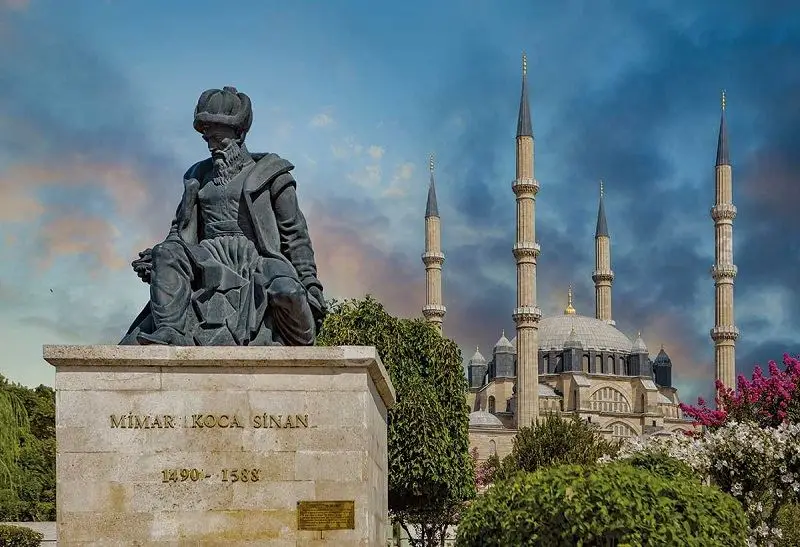
偉大な宮廷建築家、ミマール・スィナン(1490年~1588年)
Mimar Sinan, also known as Koca Mimar Sinan (Grand Architect Sinan), was born in 1490 and served as the Ottoman Empire's principal architect. His worldwide fame and acclaim attest to the quality of his work. It was as a Janissary for the Ottoman government that he first gained notoriety, but he quickly rose through the ranks to become a renowned military engineer. At age 50, he was named head of the office of royal architects and given the mandate to construct an imperial mosque called the Sehzade (Prince/Shahzade) Mosque, which is now recognized as one of the earliest masterpieces of his prolific career. Throughout his life, he served three different sultans: Suleyman the Magnificent, Selim II, and Murad III. What made him so brilliant was the way he could see how engineering and architecture could work together. To increase the amount of usable space within a structure, he tried out different variations of domes, both single and multi-dome, and, by taking this empirical approach, he was able to achieve geometric purity an integral unity. Scholars identify 477 buildings as having been designed or constructed by him, but only 196 remain standing today. Some of his most notable works include the Suleymaniye Mosque, the Mihrimah Sultan Mosque, the Kilic Ali Pasa Complex, and the Haseki Hurrem Sultan Baths. The Selimiye Mosque in Edirne is widely regarded as his masterpiece among his incredible body of work.
バリアン家(18世紀および19世紀)
The Balyans were an illustrious Ottoman Armenian architectural family responsible for some of the empire's most impressive palaces, mansions, kiosks, and mosques in the 18th and 19th centuries. Six sultans ordered them over the course of five generations, starting with Sultan Selim III and ending with Abdulhamid II.
The Balyan family rose to prominence at the turn of the 18th century, when the spread of Western ideas throughout the empire was at its height. They were instrumental in the development of the Neo-Ottoman style, which fused elements of the Neo-Classical and Baroque movements. The family designed seven palaces, including Dolmabahce, four factories, one barracks, one mosque, seven churches, two hospitals, three schools, two weirs, one fountain, and one mausoleum, with Garabed Amira being the most well-known member of the architectural staff.
All over Istanbul right now, you can find the family's magnificent creations. The tombs of Mahmud II and Abdulmecid; the Dolmabahce, Beylerbeyi, Ciragan, Yildiz, Kucuksu, Ihlamur, Baltalimani, and Adile Sultan (Kandilli) palaces; the Aynalikavak, Izmit, Mecidiyekoy, Zincirlikuyu, Ayazaga, Kalendar, and countless other mosques and palaces.
ミマール・ケマレディン・ベイ(1870年~1927年)
1870年に生まれたアフメト・ケマレディンは、一般的には「ミマール(建築家)ケマレディン」として知られています。彼はオスマン帝国の末期とトルコ共和国の初期において、建築家および修復家として名を馳せました。ヴェダト・テクとともに、建築表現においてトルコらしさを重視した「第一回国民建築運動」の先駆者となりました。ミマール・ケマレディンは、当時のドイツ建築からインスピレーションを得ていましたが、イスタンブールの歴史地区にあったタイヤレ・アパートメントに建てられていたホテルは、彼が独自のトルコ建築様式とアイデンティティを確立したことを示しています。
ヴェダト・テク(1873年~1942年)
When it comes to the First National Architectural Movement, no one can compare it to Vedat Tek. The year 1873 marks his birth in the late 19th century. He attended the prestigious French institutions of higher education, Ecole Centrale and Ecole des Beaux-Arts, in Paris after finishing high school in Galatasaray. In the early stages of his career, he served the Ottoman government in two key capacities: first, as an appointed architect for the Ministry of Post and Telegraph; and second, as the chief architect of the palaces, in which capacity he oversaw the renovation of some 20 palaces. His early works include the Kastamonu Governor's Office and the Istanbul Main Post Office. He was summoned to Ankara after the proclamation of the Republic to create the Turkish Grand National Assembly. The Haydarpasa and Moda Ferryboat Piers, the home of Sedat Tek, and the Cankaya Gazi Mansion are just a few of the other notable structures he designed and built.
トゥルグット・ジャンセヴェル(1921年 - 2009年)
Turkish architect and urban planner Turgut Cansever was born in 1921. He was the recipient of three Aha Khan Awards for Architecture. After graduating from the Istanbul State Academy of Fine Arts with a degree in architecture, he began working as Sedad Hakki Eldem's assistant. For his conceptual framework, he looked at idioms from different parts of the country. The Anatolian Club Hotel in Buyukada, Istanbul (1951–1956), and the Demir Holiday Village in Bodrum (1971) are two of his best-known works.
セイフィ・アルカン(1903年~1966年)
モダニズム建築家のセイフィ・アルカンは、1903年にイスタンブールで生まれた。彼はトルコ共和国初期に活躍した。イスタンブール美術アカデミーで実りある学習期間を過ごした後、奨学金を得てベルリンに留学し、ハンス・ペルツィヒ教授の指導を受けた。ペルツィヒ教授の教えは、彼の考え方や技術に大きな影響を与えた。彼はその時代の最も著名な建築家の一人であり、アタテュルクから、チャнкаヤ大統領官邸の設計を依頼された。彼は第一次国民建築運動の時代に活動していたが、彼の作品は他の建築家とは一線を画している。ヴェダトのように、彼のデザインのコンセプトは国民的アイデンティティに基づいているわけではなかった。 テキとミマール・ケマルッディンといった特定の建築家ではなく、普遍的な建築原理に焦点を当てている。
セダット・ハッキ・エルデム(1908年~1988年)
トルコの近代建築の先駆者の一人であるセダット・ハッキ・エルデムは、1908年に生まれました。外交官の息子であるエルデムは、幼少期と青年時代をヨーロッパで過ごし、フランス語の小学校とドイツ語の高校に通いました。トルコに戻った後、彼は美術アカデミーに入学し、そこでヴェダト・テクやグイロ・モンジェリの授業を受けました。大学を卒業するとすぐに、奨学金を利用してヨーロッパ各地を旅行しました。そこで彼はペレやペルツィヒと共同でプロジェクトに取り組み、数多くの都市を訪れました。彼の建築様式は、トルコとヨーロッパの学者たちからの教育を大きく受けて形成されました。アールデコ、国際様式、さらにはル・コルビュジエの建築様式など、さまざまな影響を受けています。 コルビュジエは彼の初期の作品に影響を与えましたが、最終的にはオスマン帝国の伝統的な建築様式を専門とするようになりました。エルデムの作品は、長年にわたって常に変化し続ける彼のダイナミックなスタイルにより、単純な分類に当てはめることが困難です。アガオール邸、イスタンブール大学の理学部、イスタンブールのフロリヤ施設などは、彼の代表的な作品のほんの一部です。
Mongeri, Allaury, and D'Aranco, three Istanbul architects of the 19th century
With the Tanzimat Reforms, the Ottoman Empire as a whole was exposed to western influences for the first time (1839–1876). As part of this transformation, Istanbul was updated in the fashion of Europe's dominant architectural style, Neo-Classicism. European architects were the first to use this style, and later Christian Ottoman architects were recruited to further spread it. To name just two examples, the first was the British architect W.J. Smith, who was hired to construct the British Embassy, and the Swiss architect Gaspare T. Fossati, who was hired to construct the Russian Embassy. Many architects, such as Valluary and Jachmund, were sent to Istanbul during the reign of Abdulhamid II to either build or research the history of Ottoman architecture. As a result of their research, a blend of Neo-Classical and Ottoman elements emerged. The School of Fine Arts (1882) and the Imperial Archeological Museum are two of Vallaury's most recognizable landmarks. Raimondo d'Aronco, on the other hand, introduced Art Nouveau elements to イスタンブールどちらも、ユルドゥズ宮殿のパビリオンとカラキョイ・モスクに見ることができます。