ルメリ要塞、イェディクレ要塞、アナドル要塞はすべて、要塞博物館(ヒサルラル博物館)で紹介されています。中でも、ルメリ要塞博物館が最も見応えがあります。この博物館は、サリイェル市にある30エーカーの広さを誇るルメリヒサル、またはボアズケセン(喉切り城)ヒサルにちなんで名付けられました。
ルメリ要塞(イスタンブール)
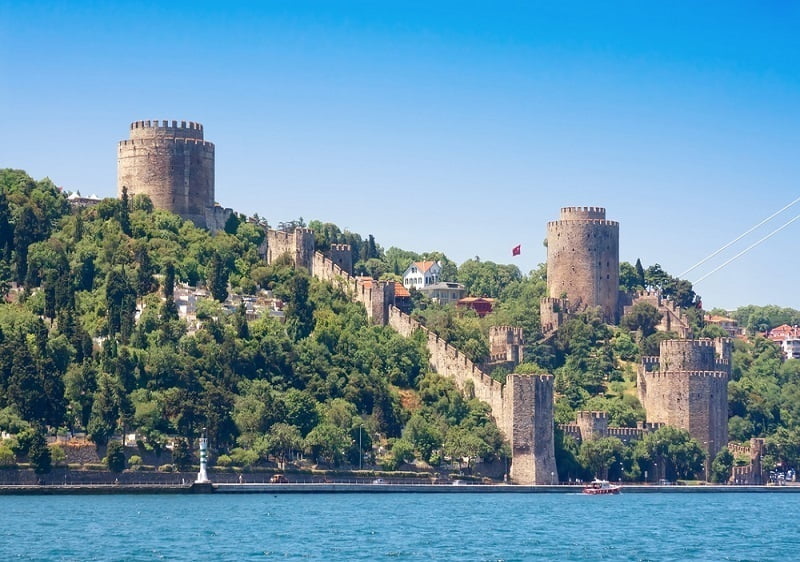
The countries of the former Ottoman Empire on the Balkan peninsula were given the name Rumeli (Diyar-i Rum) Hisar, which translates to “Fortress on the Land of the Romans.” It was constructed by Sultan Mehmet the Conqueror in 1452 prior to the conquest of Istanbul in order to manage the passing ships in the Bosphorus, to create a military-financial control point, and to implement a strong resistance base to prevent attacks from the north of the Bosphorus. 300 masters, 700–800 workers, and 200 coachmen, boatmen, and transporters reportedly worked on the fortress during this time period, according to some historical sources. Muslihiddin Aa, Mehmed II’s chief architect, designed the fortress.
要塞の建設が完了した後、フィルーズ・ベイは、そこにあるわずかな駐屯部隊の指揮を任された。彼は、要塞の前のボスポラス海峡を航行する船の指揮を執ることになった。船が定められた税を支払うようにするため、大砲は通常、水辺に近い正面の庭(ヒサル・ペチェ)に配置されていた。大砲が設置されていても、1452年には一部の船は通過することができた。しかし、1453年には、ボスポラス海峡は事実上、船舶の航行に対して閉鎖された。
Rumeli Fortress was no longer necessary for military purposes after Istanbul was conquered, so it was converted into an imperial prison and customs checkpoint. A residential neighborhood developed inside the fortress over time. Both an earthquake in 1509 and a fire in the middle of the 18th century caused significant damage to the fortress. Under Selim III’s rule, the final repairs to buildings from the Ottoman era (1789–1807) were made. Among the world’s largest surviving fortification structures are the towers at the Rumeli Fortress Museum. It faces the Anadolu Fortress, which Sultan I. Beyazt constructed in 1394 at the narrowest point of the Bosphorus. It was put to use as a proving ground for cutting-edge cannon technology. There is a cannon similar to this one on display at the Royal Armouries Museum in Fort Nelson, which is located close to the city of Portsmouth. In 1868, Sultan Abdulaziz presented the Queen with the 17-ton cannon as a gift. The Turkish words “Help O God” are carved into the muzzle. The son of Murad, Muhammad Khan, was crowned sultan. work produced by Munir Ali during the Islamic calendar month of Rajab. During the reign of Sultan Mehmed II of Turkey (1430–1481), in the year 868 (868 = 1464 A.D.), In addition to the vent, loading instructions are engraved nearby. When Sir John Duckworth attempted to force the Dardanelles Straight in 1807, the gun, despite its age, damaged six of his ships.
Kal’a-i Cedid, Kulle-i Cedide, Yenicehisar, Yenihisar, Bogazkesen Kalesi, Bogazkesen Hisar, Nikhisar (Guzelhisar), and Baskesen Hisar are just some of the names that have been used for Rumeli Fortress since it was first constructed. The timber used in the building process was shipped in from Izmit and Karadeniz Ereglisi, while the stones came from all over Anatolia, and the spolies (repurposed stone pieces) were salvaged from nearby Byzantine ruins. In 1953, on the orders of President Celal Bayar, three Turkish women architects—Cahide Tamer, Selma Emler, and Mualla Anhegger-Eyüboglu—restored the building to its former glory, and it opened to the public in 1968 under the direction of the Hisarlar Museum Directorate. Wooden homes in the area were torn down and rebuilt after the destruction of walls, bastions, and battlements. The fortress mosque (which was destroyed in the 18th century) in the center of the fortress was transformed into a stage, and the audience was given a place to sit by staggering the slope opposite, despite the fact that this was not historically accurate. Even as recently as 2008, musical performances were held in the open theater structure that had been added at that time. Due to the risk of ruining the cistern’s historic structure, these groups eventually disbanded. This circular cistern measures 15.65 meters in diameter and served as the foundation for the Fortress Masjid (Ebu’l Feth Mosque/Bogazkesen Mosque). The Byzantine-era cistern was converted into a fortress mosque by Fatih Sultan Mehmed. The Khorasan mortar used in the stone and brickwork of the cistern served as a water tank.
ルメリ要塞の所在地
The layout of the Masjid fortress is square. A wooden-hipped roof sits atop the structure. The building’s spherical minaret can be found to the west. There is a ruined minaret from the original structure next to this one. Mehmed II., his soldiers, teachers, and viziers all worshipped and prayed in this, the first mosque ever constructed in Istanbul. The Masjid’s minaret was salvaged down to its pedestal, and it reopened for worship in August 2015 after being rebuilt in the style of mosques from the Fatih Period.