Prinsøerne
Øernes historie kan spores tilbage til det antikke Grækenland, hvor de dengang blev kaldt »Dmónsoi«, og navnet blev også stavet som Demonesi eller Demonisi.
Prinsøerne, Istanbul
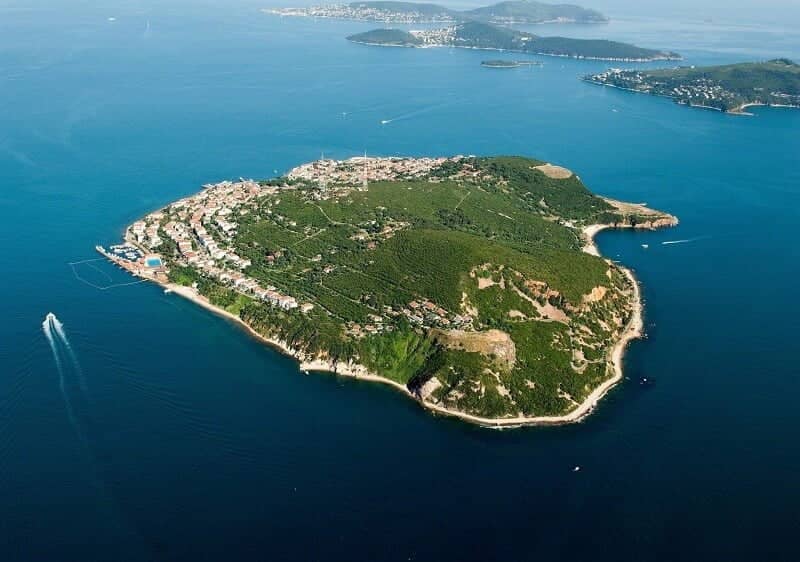
Out-of-favor princes and other members of the royal family were banished to the islands during the time of the Byzantine Empire. The Ottoman sultans’ family was also exiled there after 1453, leading to the islands’ current name. During the 1453 siege of Constantinople, the Ottoman fleet took the islands. The wealthy of Istanbul visited the islands in the nineteenth century, and on the largest of the Princes’ Islands, you can still see Victorian-era cottages and houses. The Princes’ Islands (Adalar) Kaza had a total population of 7,937 in the Ottoman General Census taken between 1881 and 1893. This included 5,501 Greeks, 533 Armenians, 254 Muslims, 133 Catholics, 65 Jews, 27 Latinos, 7 Protestants, 3 Bulgarians, and 1,404 non-Ottoman citizens. On Halki (Turkish: Heybeliada), the second-largest of the Princes’ Islands in the Sea of Marmara, a seminary called the Theological School of Halki (Greek: and Turkish: Ortodoks Ruhban Okulu) was established on October 1, 1844. Up until the Turkish parliament outlawed private universities in 1971, it served as the Ecumenical Patriarchate of Constantinople’s primary school of theology. The theological institution occupies the former site of the Byzantine Monastery of the Holy Trinity on the island’s Hill of Hope. The monastery continues to care for the former school building, which is now used for conferences. It takes about an hour to travel by boat from the coast of Istanbul to the island where it is located. It was estimated that there were 10,250 Greeks and 670 Turks living on the islands back in 1912. Since the British Yacht Club on Büyükada was appropriated as Anadolu Kulübü for Turkish parliamentarians to enjoy Istanbul in the summer, the islands have taken on a more ethnically Turkish character as a result of the influx of wealthy Turkish jet setters. This trend began in the 1920s, during the early days of the Turkish Republic. The islands are unique in that they provide a glimpse, albeit partial, into a multiethnic community in contemporary Turkey, perhaps similar to the multiethnic communities that flourished in Ottoman cities like Istanbul and Constantinople. There were sizable populations of Turkic-speaking people on every inhabited island before the 1950s, but this is no longer the case. Since Turks make up such a large proportion of the population and tourist trade, the minority’s historical contributions are now more significant culturally than statistically.
Prinsøernes beliggenhed
Büyükada
The Princes’ Islands, located in the Marmara Sea not far from Istanbul, include nine islands, the largest of which is called Büyükada (Turkish for “Big Island”; Greek: romanized as Prnkpos). Visitors can get around on foot, by bicycle (many shops rent them out by the hour), or in battery-powered electric vehicles that operate like taxis and offer “round-the-island” sightseeing tours, just like on the other islands. Due to a serious equine disease, the island’s use of horse-drawn carriages was discontinued in 2020. As part of their exile, the Byzantine empresses Irene, Euphrosyne, Theophano, Zoe, and Anna Dalassena were housed in a convent in Büyükada. Leon Trotsky spent his first four years in exile on the island of Büyükada after being expelled from the Soviet Union in February 1929. The island is the place of origin for Princess Fahrelnissa Zeid. The Ayia Yorgi Church and Monastery, which dates back to the sixth century, the Ayios Dimitrios Church, and the Hamidiye Mosque, which was constructed by Abdul Hamid II, are just a few of the historical buildings in Büyükada. There are two peaks that makeup Büyükada. The former Greek Orphanage, a massive wooden structure now known as the Prinkipo Environmental Center, sits atop Hristos hill, the one closest to the iskele (ferry landing). The former fairground known as Luna Park and the Ayios Nikolaos church and monastery is located in the valley between the two hills. The “classic” Ayia Yorgi (St. George, in Greek: ) experience includes taking the “small tour” of the island by buggy to this point and then walking the short distance up to the tiny church.
Heybeliada
Located in the Sea of Marmara, Heybeliada (Turkish for “Saddlebag Island”; Greek: romanized: Chalk, also rendered Halki) is the second largest of the Princes’ Islands. Located in Istanbul’s Adalar neighborhood, As you step off the ferry, look to your left to see the massive Naval Cadet School perched above the jetty. The school has two unique buildings that are worth exploring. One is Kamariotissa, the last Byzantine church built before the fall of Constantinople and the only one still standing on the island. The other is the grave of Edward Barton, the second English ambassador sent by Elizabeth I of England to Constantinople, who preferred to reside on Heybeli due to its relative seclusion. There are bars and cafes, an all-year-round hotel, and many picturesque wooden homes to the right of the jetty in town. The Halki Seminary, the only Greek Orthodox seminary in Turkey and the Theological Seminary of the Ecumenical Patriarchate, was housed in a Greek Orthodox monastery that dates back to the eleventh century and was arbitrarily closed by the Turkish government in 1971. Despite the Turkish Government’s promise to reopen the seminary, the monastery continues to attract visitors from all over Greece and Turkey. Service vehicles like ambulances, fire trucks, and police cars are the only vehicles allowed on the island to prevent pollution. Foot, horse, and buggy travel, plus the occasional service vehicle, are your only options for getting around. The only practical means of transportation are ships, as there is no airport. There are only about 3,000 people living on the island in the winter, but that number increases to about 10,000 when the owners of the seasonal homes return. A resident naval band tours the island every year to commemorate Independence Day, and there are also small-scale open-air concerts hosted by the local council and a swimming and fitness club right by the water that draws a lot of attention during the summer.
Burgazada
Third in size is Burgazada, also known as “Fortress Island” in Turkish (Greek: Antigone, romanized as Antigone), which consists of a single hill about 2 km in diameter. Demetrius I of Macedon, one of Alexander the Great’s Diadochi (successors), constructed a fort here and gave it the name Fort Antigonus I Monophthalmus in honor of his father. The island was given this name, but most Turks today refer to it simply as “Burgaz” (Turkish for “fort”). Burgaz experienced a forest fire in 2003, destroying 4 square kilometers of forest. Sait Faik Abasyank’s works are frequently set in Burgaz, where he also lived. His home is now preserved as a museum. His bronze likeness can be found at his favorite restaurant in Kalpazankaya (the counterfeiter’s rock), where he would often relax with a glass of raki that the proprietors would refill daily. Prior to the middle of the twentieth century, Burgazada was a largely Jewish community.
Kinaliada
Kinaliada (tyrkisk for "Henna-øen", opkaldt efter jordens farve; græsk: transskriberet som Prt, "Første") er den ø, der ligger tættest på både den europæiske og den asiatiske side af Istanbul, og den ligger kun 12 kilometer (7 miles) sydpå. Jorden er rødlig på grund af jern og kobber, som er blevet udvundet her, og dette er en af de øer, der har færrest træer. Det Byzantinske Rige brugte denne ø som et eksilsted oftere end nogen anden (de mest kendte eksilerede var de tidligere kejsere Romanos I Lekapenos i 944 og Romanos IV Diogenes efter slaget ved Manzikert i 1071). Et andet historisk vartegn, et kloster, ligger på toppen af denne ø. Kinaliada havde den største koncentration af armeniere i Istanbul i det 19. århundrede og frem til midten af det 20. århundrede, selvom de fleste kun havde sommerhuse der. Der var primært armenske sommergæster på øen. De armenske patriarker i Istanbul tilbragte somrene på øen. Der er færgeforbindelser, der afgår fra Kabataş på den europæiske side og transporterer passagerer til øerne. Hurtige færger gennemfører turen på omkring 25 minutter, mens langsommere færger tager omkring 40 minutter (Vapur).