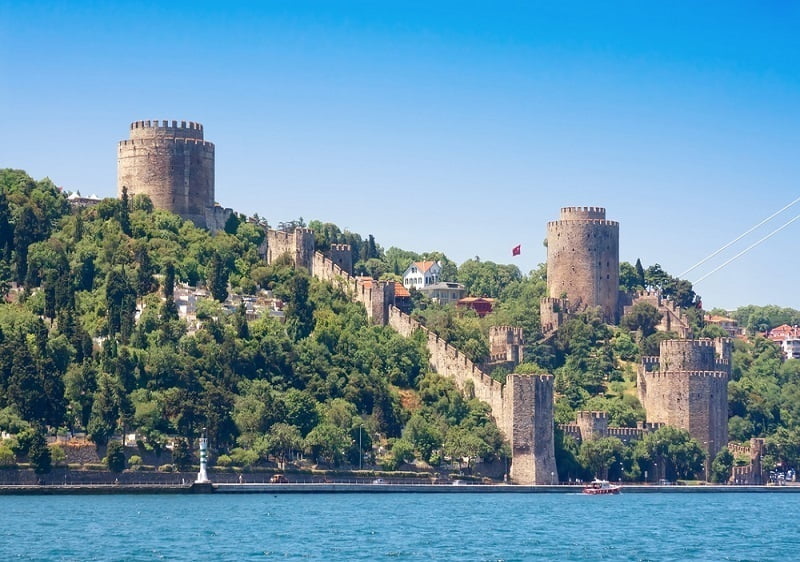
루멜리 요새, 예디쿨레 요새, 아나돌루 요새는 모두 요새 박물관(히사르 박물관)에 전시되어 있습니다. 이 중에서도 루멜리 요새 박물관이 가장 인상적입니다. 이 박물관은 사리예르 시에 있는 30에이커 규모의 루멜리히사르 또는 보가지케센(목을 베는 성) 히사르에서 이름을 따왔습니다.
루멜리 요새, 이스탄불
The countries of the former Ottoman Empire on the Balkan peninsula were given the name Rumeli (Diyar-i Rum) Hisar, which translates to “Fortress on the Land of the Romans.” It was constructed by Sultan Mehmet the Conqueror in 1452 prior to the conquest of Istanbul in order to manage the passing ships in the Bosphorus, to create a military-financial control point, and to implement a strong resistance base to prevent attacks from the north of the Bosphorus. 300 masters, 700–800 workers, and 200 coachmen, boatmen, and transporters reportedly worked on the fortress during this time period, according to some historical sources. Muslihiddin Aa, Mehmed II’s chief architect, designed the fortress.
요새가 완공된 후, 피루즈 베이는 그곳에 배치된 소규모 병력의 지휘를 맡게 되었습니다. 그는 요새 앞 보스포루스 해협을 통과하는 선박들을 지휘하는 임무를 맡았습니다. 대포는 일반적으로 요새 앞 정원(히사르 페체)의 해안가에 배치되어 선박들이 필요한 세금을 납부하도록 했습니다. 대포가 있었음에도 불구하고, 일부 선박은 1452년에 해협을 통과할 수 있었습니다. 그러나 1453년에는 보스포루스 해협이 사실상 해상 교통에 대해 폐쇄되었습니다.
Rumeli Fortress was no longer necessary for military purposes after Istanbul was conquered, so it was converted into an imperial prison and customs checkpoint. A residential neighborhood developed inside the fortress over time. Both an earthquake in 1509 and a fire in the middle of the 18th century caused significant damage to the fortress. Under Selim III’s rule, the final repairs to buildings from the Ottoman era (1789–1807) were made. Among the world’s largest surviving fortification structures are the towers at the Rumeli Fortress Museum. It faces the Anadolu Fortress, which Sultan I. Beyazt constructed in 1394 at the narrowest point of the Bosphorus. It was put to use as a proving ground for cutting-edge cannon technology. There is a cannon similar to this one on display at the Royal Armouries Museum in Fort Nelson, which is located close to the city of Portsmouth. In 1868, Sultan Abdulaziz presented the Queen with the 17-ton cannon as a gift. The Turkish words “Help O God” are carved into the muzzle. The son of Murad, Muhammad Khan, was crowned sultan. work produced by Munir Ali during the Islamic calendar month of Rajab. During the reign of Sultan Mehmed II of Turkey (1430–1481), in the year 868 (868 = 1464 A.D.), In addition to the vent, loading instructions are engraved nearby. When Sir John Duckworth attempted to force the Dardanelles Straight in 1807, the gun, despite its age, damaged six of his ships.
칼라-이 제디드, 쿨레-이 제디드, 예니제히사르, 예니히사르, 보가지케센 칼레시, 보가지케센 히사르, 니히사르(구젤히사르), 바슈케센 히사르 등은 루멜리 요새가 처음 건설된 이후 사용된 이름 중 일부입니다. 건축 과정에 사용된 목재는 이즈미트와 카라데니즈 에레글리에서 운송해 왔고, 돌은 아나톨리아 전역에서 가져왔으며, 재활용된 돌 조각은 인근의 비잔틴 유적에서 가져왔습니다. 1953년, 젤랄 바야르 대통령의 지시에 따라 세 명의 터키 여성 건축가, 즉 카히데 타메르, 셀마 엠러, 무알라 안헤거-에위보글루가 건물을 이전의 모습으로 복원했으며, 1968년에 일반에 공개되었습니다. 히사르 성 박물관 관리국. 이 지역의 목조 가옥들은 성벽, 요새, 방어벽이 파괴된 후 철거되었다가 재건축되었습니다. 성의 중앙에 있던 요새 사원(18세기에 파괴됨)은 무대로 탈바꿈했고, 관객을 위한 좌석 공간을 마련하기 위해 반대편 경사면에 계단식 좌석을 설치했는데, 이는 역사적 사실과는 다소 거리가 있습니다. 2008년까지도 당시 추가된 야외 극장 구조물에서 음악 공연이 열렸습니다. 하지만 저수지의 역사적 구조물을 손상시킬 위험이 있어 결국 해당 단체들은 해체되었습니다. 이 원형 저수지는 지름 15.65미터이며, 성의 기초 역할을 했습니다. 보가즈케센 모스크(에부울 페트 모스크)를 위해 요새 모스크로 개조했습니다. 비잔틴 시대의 저수지는 파티흐 술탄 메흐메트가 요새 모스크로 개조했습니다. 이 저수지의 석조 및 벽돌 공사에 사용된 호라산 모르타르는 물탱크 역할을 했습니다.
루멜리 요새 위치
The layout of the Masjid fortress is square. A wooden-hipped roof sits atop the structure. The building’s spherical minaret can be found to the west. There is a ruined minaret from the original structure next to this one. Mehmed II., his soldiers, teachers, and viziers all worshipped and prayed in this, the first mosque ever constructed in Istanbul. The Masjid’s minaret was salvaged down to its pedestal, and it reopened for worship in August 2015 after being rebuilt in the style of mosques from the Fatih Period.