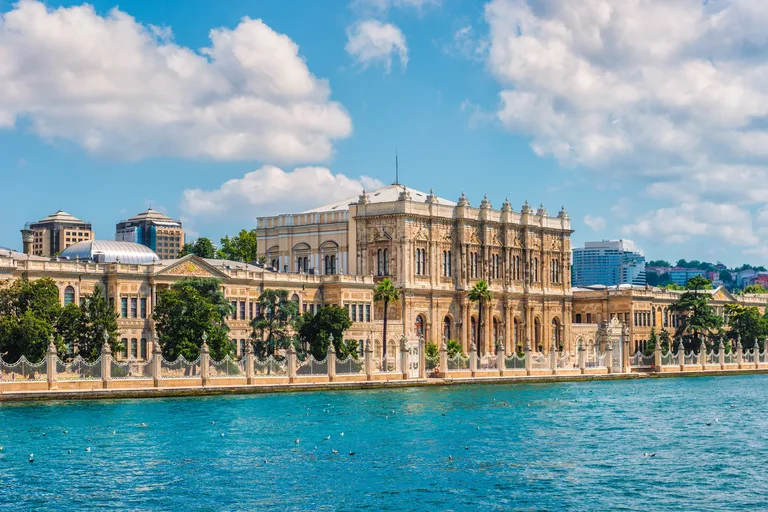
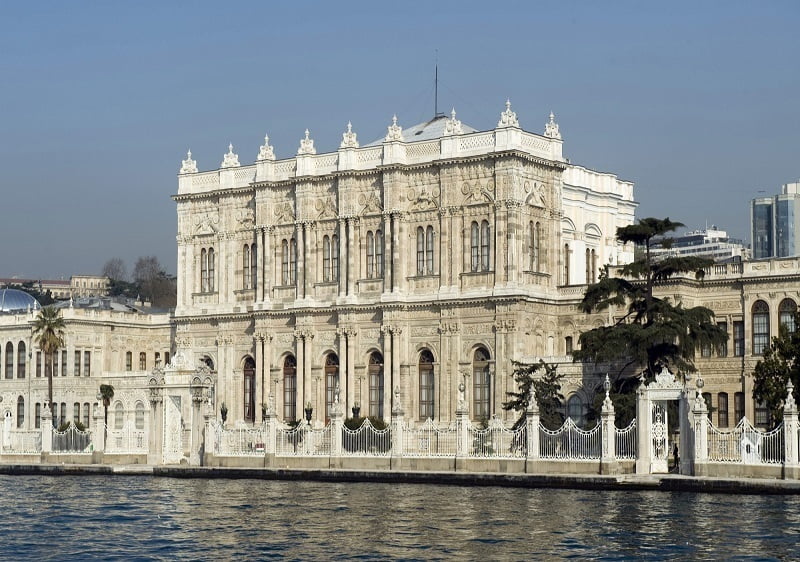
그 돌마바흐체 궁전 was built during the reign of Sultan I Abdulmecit during the 19th century; this over-ornated palace lies along the European coast of the Bosphorus. Dolmabahce Palace was constructed between 1843 and 1856, mixing different European artistic influences, and was built by Abdulmecit’s architect, Karabet Balyan. It was built over three levels and symmetrically planned, with 285 chambers and 43 halls. It has a 600m long pier along the river, with two huge monumental gates.
돌마바흐체 궁전, 이스탄불
The palace is surrounded by well-maintained and immaculate gardens, with an immense 56-columned greeting hall, with 750 lights illuminated by 4,5 tones of the crystal chandelier. The entrance was used for meeting and greeting the sultans, and opposite the ceremonial hall was the harem. The interior decoration, furniture, silk carpets, and curtains all exist with little defect.
이 궁전은 다른 대부분의 궁전에서는 찾아볼 수 없는 고급스러운 분위기를 자랑하며, 벽과 천장은 금으로 장식되어 있고, 해당 시대의 유럽 예술 작품으로 꾸며져 있습니다. 최고급 실크와 양모 카펫, 동남아시아 수공예품, 수정 촛대 등으로 각 방을 장식했습니다. 남성용 하맘(공중 목욕탕)은 대리석으로 장식되어 있으며, 하렘에는 술탄의 침실과 여성 및 하인들의 공간이 있습니다. 돌마바흐체 궁전은 터키 역사에서 또 다른 특별한 의미를 지니는데, 터키 공화국의 무스타파 케말 아타튀르크가 10년 1938월 돌마바흐체 궁전에서 세상을 떠났습니다. 그의 방은 그가 떠난 그대로 방문객에게 공개되어 있습니다.
동쪽 건물에는 미술관이 있습니다.
돌마바흐체 궁전과 주변 지역에 대한 모든 것
It was one of the Bosporus’s coves until the 17th century. In mythology, this is where the Argonauts’ ship, Argo, anchored so that they could search for the Golden Pelt; in history, it is where Sultan Mehmet the Conqueror beached his ships before crossing to the Golden Horn to conquer Istanbul.
From the seventeenth century on, this cove began to be filled in and transformed into one of the Bosporus’s most distinctive gardens, now known as Dolmabahce (Filled Up Garden).
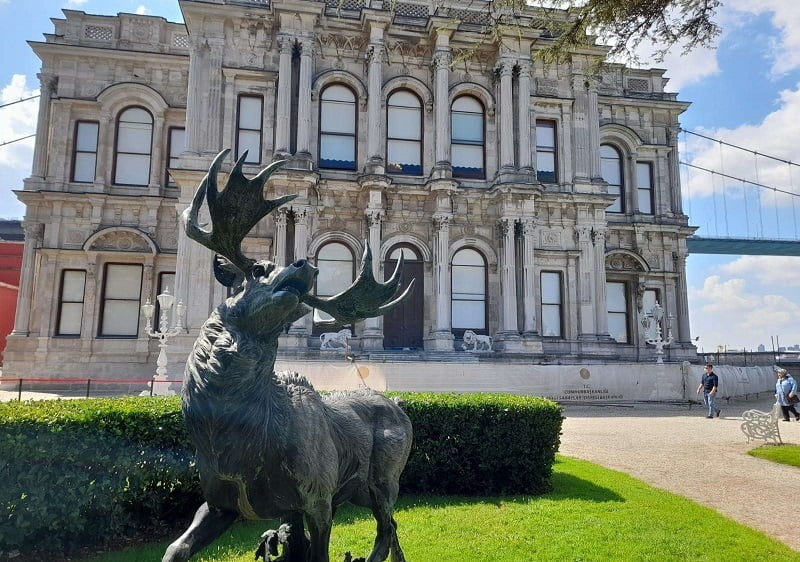
시간이 흐르면서 여러 술탄들이 돌마바흐체 궁전을 위해 별채와 정자를 지었는데, 이로 인해 현재는 “베식타스 해안 궁전”이라고 불리는 궁전이 탄생했습니다.
베식타스 해안 궁전은 압둘메지드 술탄 통치 기간인 1843년에 철거되었습니다. 술탄은 이 궁전이 나무로 지어져 시간과 돈 낭비라고 판단했기 때문입니다. 그 자리에 현재의 돌마바흐체 궁전의 기초가 놓였습니다.
In 1856, construction was completed in its entirety, including the exterior walls. Dolmabahce Palace was constructed on a site larger than 110.000 square meters, and its main building is just one of sixteen distinct sections. Stables, mills, pharmacies, kitchens, aviaries, a glass shop, a foundry, and a patisserie are just some of the buildings that make up those sectors. The Heir Apparent’s apartment gained a clock tower and lodges in the garden at the back during the reign of Sultan Abdülhamid II (1876–1909).
당시 최고의 오스만 제국 건축가였던 카라벳과 니코고스 발리안 형제가 이 궁전을 지었습니다. 하렘-이 후마윤, 무아야데(의례 홀), 마베인-이 후마윤(셀람르크)은 궁전의 주요 구역(하렘)을 구성합니다. 마베인-이 후마윤은 정부 업무가 이루어지는 곳이고, 하렘-이 후마윤은 술탄이 거주하는 곳이며, 궁전의 중앙 안뜰에 위치한 무아야데는 공식 행사와 연회가 열리는 곳입니다.
Counting the basement, Dolmabahce Palace has three stories. While the building’s form, detail, and ornamentation are all clearly influenced by Western styles, they were expertly interpreted by Ottoman architects. The floor plan, on the other hand, is a modern take on the layout of a grand, traditional Turkish home. It has stone exterior walls, brick interior walls, and wooden floors. The Palace’s central heating and electrical systems were installed between 1910 and 1912, showing that it was willing to adopt modern conveniences. In all, the Palace’s 285 rooms, 46 halls, 6 hammams (Turkish baths), and 68 restrooms take up a total of 45,000 square feet of space. The 4.454 square meters of carpeting on the fine parquet floors were woven in the palace’s loom house and then in Hereke, which is well-known for its carpets.
Regarding its purpose and splendor, the most impressive part of the building is the mabeyn, where the Sultan conducts state affairs. The entry’s Medhal (entrance) Hall, the Crystal Stairs leading to the upper floor, the Süfera (ambassadors) Hall, the guest room for the ambassadors, and the Red Room where the Sultan received the ambassadors are all decorated and furnished to emphasize the historical splendor of the Empire. Zülvecheyn (two planned) Hall provides access to the Sultan’s personal quarters in the Mabeyn wing, which are located on the upper floor. In addition to classrooms and assembly halls, this district is home to an exquisite hammam decked out in Egyptian marble.
하렘과 마베인 사이에 위치한 무아이예데(축하) 홀은 돌마바흐체 궁전에서 가장 웅장하고 화려한 공간입니다. 이 홀의 높이 36미터에 달하는 돔과 4.5톤 무게의 영국산 샹들리에는 궁전 내 다른 공간들과 차별화됩니다. 궁전 전체 면적은 15,000제곱피트이며, 기둥은 56개입니다. 가장 추운 날에도 중앙 난방 시스템 덕분에 따뜻한 공기가 기둥 아래에서 불어와 손님들은 편안하게 시간을 보낼 수 있습니다. 이 홀의 황금빛 왕좌는 전통적으로 성스러운 날을 기념하는 축하 행사 기간 동안 술탄이 고위 인사와 외교단 구성원을 맞이할 때 사용되었습니다. 외교관들을 위한 별도의 공간과 남성 공간이 마련되어 있었습니다. 여성 손님들과 궁중 오케스트라.
돌마바흐체 궁전 위치
돌마바흐체 궁전은 유럽의 궁전에서 영감을 받아 서양식으로 지어졌지만, 하렘 이곳은 독특한 공간으로 설계되었지만, 공공 공간과 사적 공간 사이의 전통적인 구분이 지금보다 덜 엄격했습니다. 톱카피 궁전과는 달리, 이곳에는 왕족이 거주하는 별도의 건물이나 별채가 없으며, 궁전 자체의 일부로, 궁전의 주요 통로를 통해 접근할 수 있습니다.
Two-thirds of Dolmabahce Palace is dedicated to the harem. As a reminder of the norm of racial separation, the passageways between Mabeyn and Muayede Hall and the Harem are guarded by iron gates and heavy timber doors. This section contains the expansive halls illuminated by the Bosporus’s reflections, as well as the bedrooms of the Sultan, his wives, concubines, sons, and daughters, as well as the study and lounge rooms. The most interesting and impressive features of the harem are the apartment of Valide Sultan (Mother Sultan), the Blue and Pink Halls, the rooms of Sultans Abdülmedjid, Abdülaziz, and Resad, the concubines’ section, the matrons’ rooms, the study and bedroom of Great Atatürk, and the many valuable artifacts, including furniture, rugs, and kilims, inscriptions, vases, chandeliers, and oil paintings.
돌마바흐체 궁전은 현재 완전히 복원되어 일반인에게 개방되었습니다. 돌마바흐체 궁전주요 전시 공간으로는 궁궐에서 가장 귀중하게 여기는 유물들을 전시하는 두 개의 “귀중품 전시관”, 국가 궁궐의 옐디즈(별) 도자기 컬렉션의 대표적인 작품들을 전시하는 “내부 보물 전시관”, 국가 궁궐의 회화 컬렉션에서 엄선한 작품들을 장기간 전시하는 “미술관”, 그리고 마베에 있는 “압둘메지드 에펜디 도서관” 등이 있습니다.
“문화 정보 센터“현재 궁궐의 로비에 있던 ‘가구 전시관’ 자리를 대신하고 있습니다. 이곳은 전국 각지의 여러 궁궐에서 진행되는 과학 연구 및 대중 강연 활동의 중심지 역할을 합니다. 도서관에는 연구자들을 위한 참고 자료 코너도 마련되어 있으며, 주로 19세기에 출판된 자료들로 구성되어 있습니다.”
시계탑, 가구 부, 조류원, 하렘, 그리고 에어 아페리언트 아파트 건물 사이의 야외 공간에 카페와 기념품 가게가 들어섰습니다. 이곳에서는 다양한 엽서, 국립 궁궐 미술 컬렉션에 있는 그림의 복제품, 그리고 문화 정보 센터에서 출판한 국립 궁궐에 대한 소개서 등을 판매합니다. 동시에 무아예데 홀과 정원에서 국내외 행사가 열립니다. 이러한 변화 덕분에 궁궐은 다시 한번 박물관과 문화 행사의 장소가 되었습니다.