
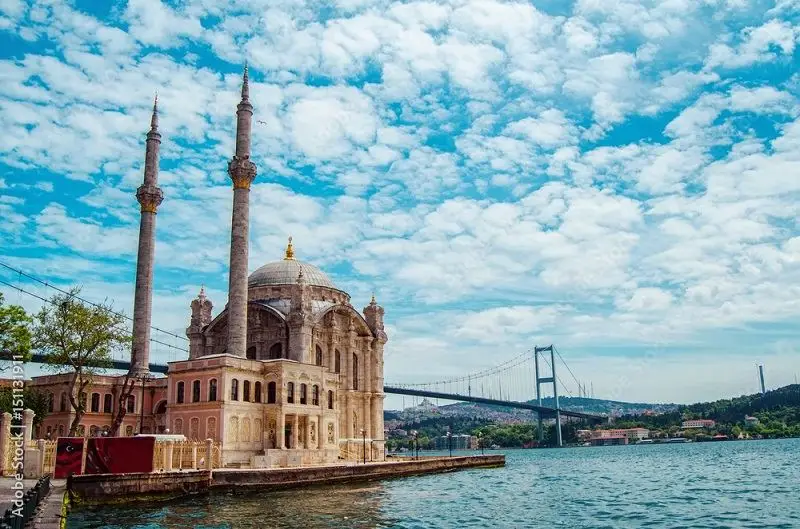
웅장한 터키 건축물
이스탄불의 궁전과 저택
돌마바흐체 궁전
돌마바흐체 궁전은 이스탄불, was originally a bay on the European side of the Bosphorus. Sultan Ahmet I and his successor Osman II gradually filled the bay to expand the imperial garden in the 17th century. Because of this, it eventually earned the name "dolmabahce," which translates to "filled garden." The Besiktas Waterfront Palace, a palace complex, was constructed within the garden in the 17th century as well. During the reign of Sultan Abdulmecid II in the nineteenth century, however, the original wooden palace was torn down and the Dolmabahce Palace was constructed on the site to serve as the main imperial palace. After many years at Fatih's Topkapi Palace, the royal family uprooted and relocated there. The illustrious Balyan family, specifically Nikogos and Karabet Balyan, built Dolmabahce Palace, one of the finest examples of the Neo-Ottoman style, which combined elements of Italian and French Renaissance art with Baroque and Ottoman architecture.
톱카피 궁전
이스탄불의 파티흐 지역(역사적인 반도)에 위치한 톱카피 궁전은 오스만 제국이 전성기를 누릴 때 행정 중심지이자 황실 거주지였습니다. 파티흐 술탄 메흐메트가 1451년에 이스탄불을 정복한 후, 1451년부터 1481년 사이에 최초의 궁전 건물들이 건설되었습니다. 가장 오래된 건물인 친일리 코슈크는 아야 소피아 광장에서 황실 문인 바브-이 후마윤을 통해 들어갈 수 있는 첫 번째 뜰에 위치해 있습니다. 궁전 건물들은 중간 문(바브-우스 셀람)을 통해 들어갈 수 있는 두 번째 뜰에 위치해 있습니다. 황실 가족과 그들의 친척들이 함께 거주했던 하렘 구역은 세 번째 뜰을 통해 들어갈 수 있습니다. 마지막으로, 가장 안쪽에 건물 내에는 네 번째 코트로 이어지는 덮개로 덮인 통로가 있으며, 이 통로는 재무실을 통해 접근할 수 있습니다.
퀴추크수 정자
The gardens of the imperial family were the inspiration for the construction of the Kucuksu Pavilion on the Asian side of the Bosphorus in what is now the Kucuksu neighborhood of Beykoz. In the early 1800s, during the reign of Sultan Mahmut, a timber palace with two stories was constructed. It was during Abdulmecid's reign in the 19th century that the original palace was torn down; before that, it had been used by Sultans Selim III and Mahmut II. Nikogos Balyan, of the well-known Balyan family, conceived of and executed the construction of the Kucuksu Pavilion. The pavilion is small because it was designed for the Sultans to use during their brief visits to the countryside or during hunting expeditions in the nearby woods.
이흘라무르 파빌리온
The Ihlamur valley, in what is now Istanbul's Besiktas neighborhood, was a popular picnic spot for the city's residents in the 18th century. However, during the reign of Sultan Abdulmecid in the nineteenth century, the Balyan family commissioned the construction of the Ihlamur Pavilions, among many other palaces and pavilions. The two pavilions, the Ceremony Pavilion and the Retinue Pavilion, are both baroque in design.
아이나르크바바크 파빌리온
Only the Aynalikavak Pavilion remains of what was once the Aynalikavak Palace, the fourth largest in Istanbul after Dolmabahce, Topkapi, and Uskudar. It was referred to as both the Tersane (shipyard) palace and the Golden Horn palace due to its location near the old shipyard on the shore of Golden Horn. The first structures of the complex were constructed in the 17th century, but by the end of the 18th century, the pavilion had become known as a palace due to many additions. These structures include the Aynalikavak Pavilion, which some believe dates back to the time of Sultan Ahmet III. However, Sultan Selim III had much of the palace demolished to expand the shipyard. Many of the classics of Ottoman classical music were written by the same Sultan while he was primarily residing at the Aynalikavak Pavilion. Dedicated to his memory, a renowned Ottoman calligrapher etched couplets on the glass.
샬레 파빌리온
When Sultan Abdulhamid II relocated from Dolmabahce Palace to Yildiz Palace in 1880, he had many new buildings constructed, including a Chalet (Sale) kiosk. Raimondo D'Aronco, a prominent Italian architect of the time, designed and constructed an annex to the palace. Many notable people, including Winston Churchill, Charles de Gaulle, and Kaiser Wilhelm II, stopped by the Sale Kiosk.
이스탄불 외곽에 있는 궁전과 저택
농업
이샤크 파샤 궁전
국가의 외딴 동남부에 위치한 도구베야지트에서 동쪽으로 5킬로미터 떨어진 곳에 이삭 파샤 궁전이 있습니다. 이곳은 튤립 시대의 18세기 네덜란드 건축 양식의 특별한 사례이며, 산비탈에 지어졌습니다. 이 궁전 단지의 디자인은 오스만, 페르시아, 아르메니아, 셀주크 양식이 절충적으로 결합된 것입니다. 외관에는 셀주크 예술을 연상시키는 부조와 조각된 돌이 사용되었습니다. 하렘 구역 문의 비문에 따르면, 이 궁전 단지는 이삭 파샤에 의해 1784년에 완공되었습니다. 또한 목재는 장식 요소로도 사용되었으며, 특히 상징적인 의미를 지닌 입체 조각 형태로 만들어진 기둥을 만드는 데 사용되었습니다. 터키 예술에서 샤크 파차는 목욕탕을 본뜬 난방 시스템을 처음으로 사용한 선구자였습니다. 19세기에 일어난 전쟁과 지진으로 인해 궁전은 심각한 피해를 입었지만, 1992년에 복원 사업이 시작되었고, 2000년에는 이 건물이 유네스코 세계문화유산 잠정 목록에 추가되었습니다.
아마시아
하제란 저택
아마시아의 얄리보유에 위치한 하제란라르 저택은 19세기 오스만 시대의 대표적인 전통 건축 양식으로 널리 알려져 있습니다. 이 지역의 유명한 거주자였던 하제란 하님은 1865년에 이 저택의 건설을 의뢰했습니다. 1986년, 대대적인 개조를 거친 후 이 저택은 민족지 박물관으로 일반에 공개되었습니다.
카라부크
사프란볼루의 전통 가옥
Safranbolu, a city in northeastern Turkey, allows us to examine Ottoman Period homes from the 18th century. Safranbolu looks like a series of terraces because of the way the river valleys have carved out the landscape. The majority of the homes are two- or three-story structures made of a mixture of wood and stone. Many of the lower stories of Ottoman homes from the 18th century were constructed from stone. The upper floors, which are buttressed, are roomy despite the narrowness of the lots. The axes of the houses are slightly shifted between stories, giving the buildings a slightly twisted appearance; this is because the upper floors were built to let in the maximum amount of sunlight.
성곽과 요새
이스탄불의 요새들
The city walls of Istanbul are an impressive sight from either the sea or the land. The walls of Constantinople, the most well-known of their type in the late antique and medieval worlds, were constructed by Byzantine Emperor Constantine the Great and encircled the city on all sides. The southern approach was protected by the Marmara walls, while the northern side of the city was encircled by the Golden Horn walls. The land walls of Constantinople protected the city from its enemies and withstood many sieges for more than a thousand years until the Ottomans conquered the city in 1453. These walls were located on the city's western side and ran for about 6 kilometers from the Sea of Marmara to the upper reaches of the Golden Horn. The inner and outer walls, towers, and moats that are still partially intact today were built by Emperor Theodosius II in the first half of the fifth century. The Ottomans have fixed up Constantinople's city walls many times over the centuries, but they still stand as reminders of the city's imperial past.
처녀의 탑
Kiz Kulesi (The Tower of the Maiden) is a tower on a small islet at the southern entrance to the Bosphorus, not far from the coast of Uskudar in Istanbul. It has been known as Leander's Tower since the Byzantine era. On a small rock in front of Uskudar, ancient Chrysopolis, a customs house was established to process cargo coming from the Black Sea. The islet's defense wall, remnants of which can be seen today in the water, once connected it to the Asian mainland. A Byzantine garrison was stationed in the tower when Istanbul was conquered by the Ottomans in 1453. Because of its association with the story of Hero and Leander, the tower is often referred to as Leander's Tower. Both an earthquake in 1509 and a fire in 1721 contributed to the tower's demise. After that, it served as a beacon. After serving as a quarantine station, Sultan Mahmud II first renovated the tower in 1832. The harbor authority then renovated it once more in 1945 and finally in 1998 for the James Bond movie "The World Is Not Enough."
현재 이 탑의 내부는 인기 있는 카페와 레스토랑으로 사용되고 있으며, 건물이 위치한 훌륭한 입지와 도시의 로마, 비잔틴, 오스만 시대의 모습을 한눈에 담을 수 있는 탁월한 전망을 활용하고 있습니다. 하루에도 여러 번 개인 소유의 보트들이 탑으로 오가며 방문객들을 태우고 내립니다.
갈라타 탑
높은 곳에 위치한 갈라타 탑은 이스탄불에서 가장 유명한 랜드마크 중 하나가 되었습니다. 이곳에서는 베요글루와 카라쾨이 지역을 한눈에 조망할 수 있습니다.
비잔티움 제국의 유스티니아누스 황제 시대인 서기 507년경, 이 탑이 처음 건설되었을 가능성이 있습니다. 제노바 사람들은 이 탑을 ‘그리스도의 탑’이라고 불렀고, 비잔티움 사람들은 단순히 ‘큰 탑’이라고 불렀습니다. 제노바 상인들이 갈라타 지역에 거주하며 지중해와 흑해 연안에 무역 거점을 설치하면서, 이 탑은 현재의 모습을 갖추게 되었습니다.
As a result of an earthquake in 1509, the tower suffered damage, but Ottoman architect Hayreddin repaired it. Hayreddin also worked on the restoration of the Sultan Bayezid II complex in Edirne. For the duration of Suleyman the Magnificent's rule, the tower housed convicts who were required to work at the Kasimpasa Naval Dockyard. At the end of the 16th century, the astrologer Takiyuddin Efendi added an observatory at the very top, but the tower was once again used as a prison between the years of 1546 and 1595, during the reign of Sultan Murat III.
The tower served as a fire observatory beginning in 1717 after having been used briefly by the Ottoman military band, the Mehter Band, in the 16th century. After a fire in 1794, the tower had to be rebuilt, and a cumba (projecting balcony) was added. The tower burned down again in 1831 and was rebuilt with an additional two stories and a conical cap.
전설적인 오스만 제국의 비행가인 헤자르펜 아흐메트 첼레비는 이 탑과 관련된 흥미로운 이야기 중 하나의 주인공입니다. 유명한 오스만 제국의 여행가인 에블리야 첼레비에 따르면, 헤자르펜 첼레비는 팔에 부착된 날개를 사용하여 탑 꼭대기에서 우스쿠다르까지 비행했습니다. 이 놀라운 광경을 본 술탄 무라트 칸은 그를 의심하게 되었고, 결국 알제리로 보냈다고 합니다.
높이 66.90미터에 달하는 이 탑은 현재 많은 사람들에게 사랑받는 명소가 되었습니다. 관광객들이 방문할 만한 장소발코니에서 바라보면 이스탄불의 멋진 전경을 감상할 수 있습니다.
디야르바크르
디야르바크르 성과 요새
The Diyarbakir fortress was initially constructed in the third century AD during the Roman Period and has since been fortified and expanded. The local basalt stone was used to construct the fortress walls, making them the second-widest and longest defensive walls in the world after China's Great Wall. In 2015, UNESCO included the Diyarbakir fortress in its list of World Heritage sites.
밴
반 성
The Urartu kingdom constructed the Van fortress in the 9th century BCE on the eastern shore of Lake Van, directly atop the remnants of their ancient capital, Tushpa. From the Medes to the Armenians to the Parthians to the Romans to the Sassanids to the Persians to the Byzantines to the Arabs to the Seljuks to the Safavids to the Afsharids to the Ottomans to the Russians, this castle has seen it all. Over the centuries, the castle has been occupied by many different cultures, and the building bears the marks of each era's inhabitants. There is an inscription from the reign of Xerxes I, who ruled in the fifth century BCE, on a mosque constructed by Sultan Suleyman in the fifteenth century.
호사프 성
The 17th-century Hosap Castle stands on the Van-Hakkari road in Van province. The rivers in the area inspired the name, which means "beautiful water." Sari Suleyman Mahmudi, chief of the Mahmudi tribe, commissioned the construction of the castle, which served as the seat of power for the province until the Tanzimat reforms of the nineteenth century.
메르신
처녀의 성
Today, you can find Kizkalesi (the Maiden's Castle) on an island in Mersin Province, just 300 meters off the coast of the Mediterranean Sea. The castle, which was originally constructed in the fourth century BCE, underwent major renovations in the thirteenth century. Their north and west walls are excellent case studies of traditional ashlar construction. The castle fell to the Anatolian emirate of Karamanid in the 13th century, and then to the Ottomans in the 14th century.
여관과 시장
악사라이
술탄하니(알라에딘 여관)
The Sultanhani (Sultan Inn), constructed by Sultan Alaeddin Kaykubat I in 1229 during the Seljuk Period, is widely regarded as one of the finest examples of Seljuk architecture. The square stone mosque in the inn's courtyard provided a space of spiritual respite for travelers, and those in the nearby city of Aksaray is particularly noteworthy, as are the engravings on the front gate.
이스탄불
그랜드 바자르
이스탄불 파티흐 지역에 위치한 그랜드 바자르는 세계에서 가장 오래된 실내 시장 중 하나입니다. 이곳에는 30,700제곱미터에 달하는 공간에 4,000개가 넘는 상점이 들어서 있습니다. 바자르의 원래 건물은 15세기로 거슬러 올라가며, 파티흐 술탄 메흐메트가 이스탄불을 정복한 이후에 지어졌습니다. 이후 술레이만 대제는 1701년에 바자르를 확장하여 현재의 규모로 만들었습니다. 수년에 걸쳐 수많은 지진과 화재로 인해 피해를 입었지만, 그 웅장함과 중요성은 여전합니다. 이곳의 상점들은 1896년 지진 이전에 지어진 것으로, 현재의 상점들이 그 자리를 이어받았습니다. 현재 이 바자르 덕분에 26,000명 이상의 사람들이 일자리를 얻고 있습니다. 이곳은 쇼핑몰로도 활용되고 있습니다. 세계에서 가장 인기 있는 역사 유적지 중 하나이며, 매일 250,000에서 400,000명에 이르는 방문객을 끌어모으고 있습니다.
향신료 시장
에미뇌뉘 지역에 있는 향신료 시장은 이스탄불에서 두 번째로 많은 방문객이 찾는 시장입니다. 이집트 시장을 포함한 새로운 모스크 단지는 1660년에 하티제 투르반 술탄이 의뢰했으며, 오스만 제국의 이집트 지방에서 얻은 수입으로 일부 자금을 충당했습니다. 향신료는 여전히 시장에서 중요한 역할을 합니다.이 지역은 경제적으로도 활발하며, 터키식 젤리 및 기타 과자, 보석, 기념품, 건조 과일 및 견과류 등을 판매하는 다양한 상점들이 모여 있습니다.
에디르네
알리 파샤 바자르
술레이만 술탄의 마지막 대장대신이었던 헤르세키 세미즈 알리 파샤는 1569년에 건축가 시난에게 이 건물의 건설을 의뢰했습니다. 이곳은 길이가 270미터에 달하며, 약 130개의 상점이 늘어서 있습니다. 현재 이 바자르에서는 의류, 신발, 가방, 기타 가정용품 등 다양한 상품과 에디르네 기념품을 판매하고 있습니다.
루스템 파샤 여관
The inn, which was constructed in 1554 at Rustem Pasha's behest by architect Mimar Sinan, is an outstanding example of Ottoman architecture from the 16th century. There are shops on the ground floor and second floor of the inn. Even though it is currently closed, the inn underwent renovations and operated as a hotel after World War II.
마드라사(신학 학교)
콘야
카라타이 메드레세
콘야의 에미르였던 젤랄레딘 카라타이는 1251년에 이 건물의 건설을 의뢰했습니다. 이 마드라사의 타일 장식과 조형물은 아름다움과 정교한 디테일로 특히 유명합니다. 쉴주크 시대의 타일, 장식품, 유물들은 현재 타일 공예 박물관으로 개조된 박물관에서 전시되고 있습니다.
시바스
고크 마드라사
1271년에 지어진 고크 마드라사는 정문 양쪽에 세워진 두 개의 첨탑으로 유명합니다. 첨탑에는 동물, 별, 나무 실루엣이 새겨져 있습니다. 푸른색 타일을 사용하여 하늘을 연상시키는 디자인을 적용했기 때문에 ‘고크’라는 이름이 붙었습니다. 건물 안에는 하나의 안뜰이 있으며, 안뜰에는 연못과 분수가 있습니다. 안뜰은 두 구역으로 나뉘어 있으며, 한쪽은 강의실로, 다른 한쪽은 예배실(메스지트)로 연결됩니다.
에르주룸
쌍둥이 첨탑이 있는 이슬람 사원
It is in the city of Erzurum, in eastern Turkey, that you'll find the Twin Minaret Madrasa (Cifte Minareli Medresesi). The madrasa likely dates back to the Seljuk era of the 13th century, but this is only a guess. The madrasa is significant not only because it is the largest structure of its kind, but also because of the architectural and decorative innovations it represents. The madrasa, which has two stories, occupies a 35-by-40-meter plot of land. The monument gets its name from the twin brick minarets that stand 26 meters tall on its northern facade. They're affixed to octagonal bases that rest atop square columns. The upper set is adorned with a relief palm tree design, while the lower set features a calligraphic medallion inscribed with Allah, the Prophet, and the four Caliphs.
종교 시설로 사용되는 건물
이스탄불
아야 소피아
Hagia Sophia, located in the Sultanahmet district of Istanbul's historical peninsula, was originally constructed in 537 in Constantinople, the capital of the eastern Roman Empire. The Eastern Roman Emperor Justinian commissioned the construction of what would become the imperial church of the Roman Empire. With the largest interior space of any building at the time, the church is often held up as a paragon of Byzantine design. Isodoros, a mathematician and architect from Miletos, conceived of the structure's layout. Following Fatih Sultan Mehmet's conquest of Istanbul, the Hagia Sophia church was transformed into a mosque. Muslim law forbids the presence of figurative art, so the church's interior was stripped out, and the mosaics were covered with plaster. In its place, Islamic elements like a minbar and minarets were installed. When the Turkish Republic was established, Hagia Sophia was transformed into a museum. Hagia Sophia, a joint Christian and Muslim temple complex, was one of the world's most impressive museums until the year 2020. With the Presidential Decree in July 2020, Hagia Sophia was reopened for worship as the Ayasofya Grand Mosque, and it now serves as a global cultural treasure.
아야 이리니 (하기아 이레네)
The Hagia Irene church, located in the first courtyard of Topkapi Palace on Istanbul's historical peninsula, was likely constructed in the 4th century. Some accounts, however, place an earlier church on the same site before Constantine I's. Before the original Hagia Sophia was constructed in 360, Hagia Irene was the official church of Constantinople. After the devastating earthquake that struck Constantinople in 740, Hagia Irene was renovated and decorated with mosaics and frescoes during the reign of Emperor Constantine V. However, following the Ottoman conquest of Istanbul in 1453, the church was enclosed within the walls of the Topkapi Palace and began to be used as an arsenal. At the turn of the 20th century, the church was first used as a military museum. It stayed that way until the late 1970s, when it was turned into a concert hall for classical music.
카리예 박물관 (코라 교회)
Originally constructed as part of a rural monastery complex outside the city walls of Constantinople, the Chora Church can be found in the Edirnekapi quartier of Istanbul, known as Kariye. Its original name was Church of the Holy Saviour in the Country, but after the city walls were expanded and it was incorporated into the city proper, it became known simply as Chora. In the 12th century, Maria Dukaina, the mother-in-law of Byzantine Emperor Alexius Komnenos, rebuilt the church into its current form. The famous mosaics and frescoes were added by the powerful Byzantine statesman Theodore Metochites in the 14th century. One of the best examples of Palaiologan Renaissance art can be found in the church's mosaics. The church was turned into the Kariye Mosque after Istanbul was conquered, and the frescoes and mosaics inside were covered with plaster. The frescoes were discovered during a lengthy restoration process after the mosque was transformed into a museum in 1945. The Kariye Mosque, which has been turned into a museum while extensive restoration work continues, will remain closed until the year 2020.
술탄 아흐메트 모스크(블루 모스크)
Sultanahmet Mosque, also known as the Blue Mosque, is an active mosque from the Ottoman era located in the Fatih neighborhood on Sultanahmet Square. The mosque was built in the early modern period, between 1609 and 1616, by Sultan Ahmet I. Its interior is adorned with ornate mosaics and mosaic domes. The town of Iznik, Turkey, is famous for the superior quality of the Iznik tiles that feature blue as the dominant color. More than 20,000 tiles in more than 50 different tulip designs adorn the lower levels. The mosque's high number of minarets (six) is another notable aspect, as it is in keeping with the mosque's grandiosity and the overwhelming interior decoration.
쉴레이마니예 모스크
뛰어난 건축가였던 시난은 술레이만 술탄(술레이만 대제)의 의뢰를 받아 오스만 제국 시대의 가장 중요한 황실 모스크 중 하나인 술레이마니예 모스크를 건설했습니다. 콘스탄티노플 전체를 내려다보는 언덕에 위치한 술레이마니예 모스크는 규모가 크고 웅장하며, 전략적인 위치 덕분에 압도적인 분위기를 자아냅니다. 2019에 잠흘리카 모스크가 건설되기 전까지는 이스탄불에서 가장 큰 모스크라는 타이틀을 유지했습니다.
밴
아크다마르 교회
The Akdamar Church was constructed between the years 915 and 921 on Akdamar Island, which is part of Lake Van in the province of Van in eastern Turkey. Bishop Manuel, an architect, was tasked with the project after it was commissioned by Gagik I Ardzruni, the king of Armenia. The "Hripsime Type" is characterized by its construction from red cut tufa stone and its design resembling a four-lobed clover. Architectural reliefs depicting religious scenes adorn the church's exterior. They are widely hailed as some of the finest manifestations of medieval art. Bible-themed frescoes adorned the interior walls. While it has been a museum since 2007 (when it was closed for good), the church is still open once a year for religious services.
안탈리아
성 니콜라스 교회
현재 터키 남동부에 위치한 고대 도시 미라는 성 니콜라스 교회가 있는 곳입니다. 성 니콜라스 교회는 고대 동로마 제국의 바실리카 양식으로 지어진 교회입니다. 이 건물은 서기 520년에 성 니콜라스의 무덤 위에 세워졌으며, 현대에는 산타클로스 또는 크리스마스 아버지로 더 잘 알려져 있습니다. 이 교회는 단순한 예배 장소일 뿐만 아니라 비잔틴 건축의 훌륭한 예시이며, 터키에서 가장 아름다운 프레스코화 중 일부를 소장하고 있어 중요한 의미를 지닙니다.
트라브존
수멜라 수도원
The Orthodox Sumela Monastery can be found in the Zigana Mountains of Trabzon Province, Turkey, which is on the northern Black Sea coast of the country. The exact date of the monastery's construction is unknown, but it is thought to have begun in the 4th century, during the reign of Emperor Theodosius I. The monastery is a stunning structure, built on rocks and accessible via a path through the forest, and is particularly well-known for its 18th-century frescoes depicting biblical scenes from the lives of Christ and the Virgin Mary. The monastery was closed and turned into a museum in 1923, but on August 15, 2010, it hosted an Orthodox Mass for the first time since then.
에디르네셀리미예 모스크이 사각형 모스크는 웅장한 돔 하나와 가늘고 높은 첨탑 네 개를 갖춘 건축물로, 유네스코 세계문화유산으로 지정되어 있습니다. 16세기 술레이만 대제의 통치 시기 오스만 제국의 전성기에 활동했던 건축가 시난은 의심할 여지 없이 가장 뛰어난 건축가였습니다. 유명한 건축가 of the Ottoman period. Edirne, formerly known as Hadrianapolis, was the Ottoman capital before Istanbul and is home to the Selimiye Mosque. Selimiye Mosque was Sinan's "masterpiece," according to the architect himself. At the age of eighty, during the reign of Sultan Selim II, he built the Selimiye Mosque (1568–1575).
Sinan's skill as a city planner is further evidenced by the mosque's prominent location, which allows it to be admired from far away. As the finest example of any mosque with eight columns, this structure is the pinnacle of his centralized-domed plans, with a great central dome rising on eight massive columns and impressive, recessed arcades in between. Typical of Ottoman mosque design is the soaring, elegant domes and towering, skinny minarets. The Selimiye Mosque, on the other hand, is one of the most beautiful and historically significant mosques in the world. It is a massive complex that includes a mosque, two square madrasas, a shopping arcade (arasta), and a theological school that measures 190 by 130 meters. The structure is supported by eight enormous columns and eight smaller muqarnas domes. The muqarnas extend outward and rise, producing a corbelled effect and leaving more floor space below so that the eye can be drawn directly to the dome.
앙카라하지 바이라므 모스크앙카라 성곽 외곽 지역에 위치한 울루스 지역에는 하지 바야람 모스크가 있습니다. 이곳에는 1923년에 터키 최초의 의회 건물이 세워졌으며, 하지 바야람 모스크와 아우구스투스 신전과 같은 오스만 제국 시대 및 초기 공화국 시대 건물과 함께 전통적인 역사적 구조를 이루고 있습니다. 이 지역은 한때 고분이었던 언덕 위에 자리 잡고 있습니다. 이 지역은 기원전 8세기부터 이교도와 무슬림 공동체 모두에게 신성한 장소로 여겨져 왔으며, 당시에는 고대 앙키라의 아크로폴리스 역할을 했습니다.
The Haci Bayram Mosque, which dates back to the 15th century, is one of the most significant mosques in Ankara and continues to play a significant role in the city's religious life. In the eighteenth century, it underwent a transformation that made it look like a mosque from the late modern era. The absence of a dome and the use of a wooden ceiling are the mosque's most distinctive architectural features. Designer Mehmet Bey was responsible for its construction.
저수지와 수도교
이스탄불
바실리카 지하 저수지
The Basilica Cistern is Istanbul's largest and oldest underground water reservoir still in use today. Southwest of Hagia Sophia, on First Hill, is where you'll find the cistern. Before the cistern was built, there stood a massive basilica, erected in the third and fourth centuries B.C. during the Early Roman era as a commercial, legal, and artistic hub. In 476, a fire swept through the building and put it out of commission forever. In the early sixth century, during the reign of Emperor Justinian I, the Basilica Cistern was constructed. The cistern supplied water to the Great Palace and other nearby structures, including gardens, courtyards, and palaces. Water piped in from the Belgrade forest, 20 kilometers away, was used to fill the cistern. The Yerebatan Palace (Yerebatan Sarayi) is 138 by 64 meters in size and is held up by 336 columns that were relocated from other ancient structures. It is estimated that 100,000 metric tons of water can be stored in the cistern. Topkapi Palace's water supply came from this cistern, the only ancient cistern still in use in modern times. In 1985, the cistern was renovated, and wooden walking platforms were added; the structure has been a museum since 1987.
우준케메르(긴 수로)
It was in 1563, during the reign of Sultan Suleyman the Magnificent, that Architect Sinan built the Long Aqueduct as part of the Kirkcesme Water Supply System. This was the biggest job this well-known architect had ever worked on. The line's buildings were damaged by the devastating floods of the same year, but they were quickly repaired. Because of this, we can assume that the Kirkcesme water system was finished in the year 1564. The Belgrade Forest is located in northern Istanbul, and this system collects surface water from the area around it and transports it into the city. The western and eastern branches are the two most prominent parts of the system. The Long Aqueduct can be found in the west. There are a total of 33 massive aqueducts that make up the system. One of these aqueducts, known as the Long Aqueduct, features 97 individual arches to carry water under the ground. It has a length of 711 meters and a height of 25 meters.
키리크케메르(무너진 수도교)
The Kirikkemer Broken Aqueduct is a component of Sinan's Kirikcesme Water Supply System, which was completed in 1564. To transport water throughout the city, the Kiriksesme water system uses 33 aqueducts and 55,374 meters of conduit lines. It has two branches—one to the east and one to the west—and collects water from sources in the city's northern reaches. In Kemerburgaz, on the line's eastern branch, you'll find the Broken Aqueduct. It has a length of 207 meters and a height of 35 meters, making it the tallest aqueduct in the system. Three of the arches have been positively identified as late Roman relics. Because of its abrupt 90-degree turn after a certain point, the Kirik (broken) or Egri (curved) Aqueduct has earned its unwieldy nicknames.
발렌스 수도교
Istanbul's ancient water distribution system includes the Valens Aqueduct. The Thracian Water Supply System, of which remnants exist, is the largest ancient water distribution network known. The Valens Aqueduct brought water from the Thracian peninsula to the city's core, where it filled the Nymphaeum Maximum in the Theodosius Forum (Beyazit Square) and then the Binbirdirek Cistern. During the time of the Roman Emperor Valens, the building was finished (364–378). The building's original length was likely around 971 meters, and its height was likely around 27 meters. In the Middle Ages, the system was still in use, despite several supply line interruptions caused by earthquakes and war. The aqueduct became part of the city's primary water distribution system in the 15th century (during the reign of Sultan Mehmet II).
병원과 목욕탕
시바스
디브리기 모스크와 병원
It's a pretty cool mosque/hospital complex. Sivas Province is home to the Divrigi Castle, as well as the Divrigi Mosque and Hospital. Turan Melek, Ahmet Shah's wife, established the two-story hospital in 1228–1229; architect Hurrem Shah also designed the mosque. They buried both Ahmet Shah and Turan Melek in the hospital's tomb section. Vault construction and carved decorations are two of the complex's most recognizable features. Porticoes, mihrabs, minbars, and piers are all lavishly adorned. Its rich examples of Anatolian traditional stonework, in addition to its architecture, earned it a spot on the UNESCO World Heritage List.
아마시아
다루시파(병원 및 요양원)
튀르키예 아마시아에 위치한 다루시파는 흑해 연안에 자리 잡은 건강 및 웰니스 센터이자 요양 시설입니다. 14세기 초, 일칸 왕조 시대에 술탄 올카이토의 부인 이디즈 하툰이 남편의 이름을 따 세웠습니다. 다루시파는 치료와 교육을 모두 제공하는 의료 센터로, 튀르키예-이슬람 문화에서 흔히 볼 수 있는 자선 재단의 모델을 따라 환자들에게 무료로 서비스를 제공했습니다. ‘건강의 문’이라는 뜻의 다루시파는 아랍어 단어를 직역한 것입니다. 건물은 아치형 복도와 방, 그리고 양쪽에 아치가 있는 안뜰로 구성되어 있습니다. 건물은 전통적인 이슬람 학교 또는 마드라사를 연상시킵니다. 저명한 의사였던 사분주자데 세라페딘 빈 알리는 그곳에서 의학 교육을 받았습니다. 그가 쓴 책인 《키타브-울 세라히야-이 일하니예》(일하나트 왕조의 외과서)는 그를 유명하게 만들었습니다. 이 건물은 과거 정신 질환자들을 위한 치료법으로 음악을 사용한 역사를 가지고 있으며, 현재도 음악 치료를 활용하고 있습니다. 1997년부터 시립 음악원으로 사용되어 왔으며, 그 이후로도 계속 운영되고 있습니다.
부르사
부르사의 고대 온천
Bursa, also known as ancient Prusa, is a historical town in the northwest of Turkey that is well-known for its natural hot spring baths. Cekirge, a village in Turkey, is well known for its therapeutic hot springs and has numerous such baths spread throughout the town. In the sixth century, during the reign of Eastern Roman Emperor Justinian I, the original baths of Cekirge were constructed. In the following centuries, during the Ottoman period, the Byzantine domed baths were renovated and enlarged by Sultan Beyazit II, and today they continue to attract tourists. The "silver water" of Bursa is said to come from the mythical Mount Olympus in Mysia, and it is used in many of the city's old Turkish baths.
이즈니크
이스마일 베이 목욕탕
지역의 저명한 인물이었던 이스마일 베이는 이즈니크의 이스탄불 문 근처에 있는 작은 하맘(터키식 목욕탕)을 개인 목욕탕으로 사용했을 것으로 추정됩니다. 15세기와 16세기에 지어진 이 목욕탕의 돔은 아름다움으로 유명합니다.
분수대
독일 분수
The German Fountain (or Kaiser Fountain) is one of many historic fountains on Sultanahmet Square in Istanbul's historical peninsula. Between 1988 and 1901, the fountain was handcrafted in Germany and then shipped to Istanbul, where it was put together. Kaiser Wilhelm II of Germany commissioned the construction of the octagonal, neo-Byzantine-style fountain as a gift to the city of Berlin. Golden mosaics adorn the interior of the dome's ceiling.
미흐리샤 술탄 분수Located in the Kucuksu district's Pavilion, this fountain was commissioned by Sultan Selim III in 1806 to honor his mother, Mihrisah Sultan. The building, which is near the Bosphorus, has become a symbol of the area because it is often shown in old drawings of the area.