Đảo Hoàng tử
Lịch sử của các hòn đảo này bắt nguồn từ thời Hy Lạp cổ đại, khi chúng được gọi bằng cái tên “Dmónsoi”, đôi khi cũng được viết là Demonesi hoặc Demonisi.
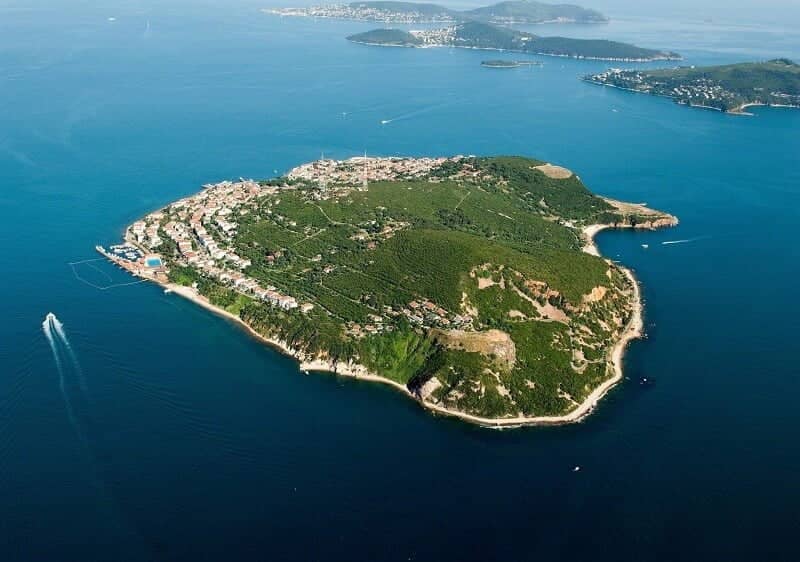
Quần đảo Hoàng tử, Istanbul.
Out-of-favor princes and other members of the royal family were banished to the islands during the time of the Byzantine Empire. The Ottoman sultans’ family was also exiled there after 1453, leading to the islands’ current name. During the 1453 siege of Constantinople, the Ottoman fleet took the islands. The wealthy of Istanbul visited the islands in the nineteenth century, and on the largest of the Princes’ Islands, you can still see Victorian-era cottages and houses. The Princes’ Islands (Adalar) Kaza had a total population of 7,937 in the Ottoman General Census taken between 1881 and 1893. This included 5,501 Greeks, 533 Armenians, 254 Muslims, 133 Catholics, 65 Jews, 27 Latinos, 7 Protestants, 3 Bulgarians, and 1,404 non-Ottoman citizens. On Halki (Turkish: Heybeliada), the second-largest of the Princes’ Islands in the Sea of Marmara, a seminary called the Theological School of Halki (Greek: and Turkish: Ortodoks Ruhban Okulu) was established on October 1, 1844. Up until the Turkish parliament outlawed private universities in 1971, it served as the Ecumenical Patriarchate of Constantinople’s primary school of theology. The theological institution occupies the former site of the Byzantine Monastery of the Holy Trinity on the island’s Hill of Hope. The monastery continues to care for the former school building, which is now used for conferences. It takes about an hour to travel by boat from the coast of Istanbul to the island where it is located. It was estimated that there were 10,250 Greeks and 670 Turks living on the islands back in 1912. Since the British Yacht Club on Büyükada was appropriated as Anadolu Kulübü for Turkish parliamentarians to enjoy Istanbul in the summer, the islands have taken on a more ethnically Turkish character as a result of the influx of wealthy Turkish jet setters. This trend began in the 1920s, during the early days of the Turkish Republic. The islands are unique in that they provide a glimpse, albeit partial, into a multiethnic community in contemporary Turkey, perhaps similar to the multiethnic communities that flourished in Ottoman cities like Istanbul and Constantinople. There were sizable populations of Turkic-speaking people on every inhabited island before the 1950s, but this is no longer the case. Since Turks make up such a large proportion of the population and tourist trade, the minority’s historical contributions are now more significant culturally than statistically.
Vị trí của Đảo Hoàng tử.
Đảo Büyükada
The Princes’ Islands, located in the Marmara Sea not far from Istanbul, include nine islands, the largest of which is called Büyükada (Turkish for “Big Island”; Greek: romanized as Prnkpos). Visitors can get around on foot, by bicycle (many shops rent them out by the hour), or in battery-powered electric vehicles that operate like taxis and offer “round-the-island” sightseeing tours, just like on the other islands. Due to a serious equine disease, the island’s use of horse-drawn carriages was discontinued in 2020. As part of their exile, the Byzantine empresses Irene, Euphrosyne, Theophano, Zoe, and Anna Dalassena were housed in a convent in Büyükada. Leon Trotsky spent his first four years in exile on the island of Büyükada after being expelled from the Soviet Union in February 1929. The island is the place of origin for Princess Fahrelnissa Zeid. The Ayia Yorgi Church and Monastery, which dates back to the sixth century, the Ayios Dimitrios Church, and the Hamidiye Mosque, which was constructed by Abdul Hamid II, are just a few of the historical buildings in Büyükada. There are two peaks that makeup Büyükada. The former Greek Orphanage, a massive wooden structure now known as the Prinkipo Environmental Center, sits atop Hristos hill, the one closest to the iskele (ferry landing). The former fairground known as Luna Park and the Ayios Nikolaos church and monastery is located in the valley between the two hills. The “classic” Ayia Yorgi (St. George, in Greek: ) experience includes taking the “small tour” of the island by buggy to this point and then walking the short distance up to the tiny church.
Heybeliada
Nằm ở Biển Marmara, Heybeliada (tên tiếng Thổ Nhĩ Kỳ có nghĩa là “Đảo Túi Yên”; tiếng Hy Lạp: Chalk, đôi khi được viết là Halki) là hòn đảo lớn thứ hai trong quần đảo Hoàng tử. Nằm ở khu Adalar của Istanbul, khi bạn bước xuống phà, hãy nhìn sang bên trái để thấy Trường Huấn luyện Sĩ quan Hải quân đồ sộ nằm trên đỉnh bến tàu. Trường có hai tòa nhà độc đáo rất đáng để khám phá. Một trong số đó là Kamariotissa, nhà thờ Byzantine cuối cùng được xây dựng trước khi Constantinople thất thủ và là nhà thờ duy nhất còn tồn tại trên đảo. Tòa nhà còn lại là lăng mộ của Edward Barton, nhà ngoại giao người Anh thứ hai được Nữ hoàng Elizabeth I của Anh cử đến Constantinople, người đã chọn sống ở Heybeli vì sự yên tĩnh tương đối của hòn đảo này. nơi đây rất yên tĩnh. Ở phía bên phải bến tàu trong thị trấn, có các quán bar và quán cà phê, một khách sạn mở cửa quanh năm và nhiều ngôi nhà gỗ đẹp như tranh vẽ. Trường Thần học Halki, trường thần học Chính thống giáo Hy Lạp duy nhất ở Thổ Nhĩ Kỳ và Trường Thần học của Tòa Thượng Phụ Chung, tọa lạc trong một tu viện Chính thống giáo Hy Lạp có từ thế kỷ thứ mười một và đã bị chính phủ Thổ Nhĩ Kỳ đóng cửa một cách tùy tiện vào năm 1971. Mặc dù chính phủ Thổ Nhĩ Kỳ đã hứa sẽ mở cửa lại trường, nhưng tu viện vẫn tiếp tục thu hút du khách từ khắp Hy Lạp và Thổ Nhĩ Kỳ. Chỉ có các phương tiện phục vụ công cộng như xe cứu thương, xe chữa cháy và xe cảnh sát được phép lưu thông trên đảo để ngăn ngừa ô nhiễm. Người dân và du khách có thể đi bộ, đi ngựa hoặc đi xe kéo. ngoài ra, thỉnh thoảng có thêm một vài phương tiện phục vụ, đó là những lựa chọn duy nhất để di chuyển trên đảo. Phương tiện di chuyển thực tế duy nhất là tàu thuyền, vì không có sân bay. Vào mùa đông, chỉ có khoảng 3.000 người sinh sống trên đảo, nhưng con số này tăng lên khoảng 10.000 khi những người chủ các ngôi nhà nghỉ dưỡng theo mùa trở về. Một dàn nhạc hải quân của địa phương đi biểu diễn khắp đảo mỗi năm để kỷ niệm Ngày Độc lập, và còn có các buổi hòa nhạc ngoài trời nhỏ do hội đồng địa phương tổ chức, cùng với một câu lạc bộ bơi lội và thể dục ngay gần bờ biển, thu hút nhiều sự chú ý vào mùa hè.
Burgazada
Third in size is Burgazada, also known as “Fortress Island” in Turkish (Greek: Antigone, romanized as Antigone), which consists of a single hill about 2 km in diameter. Demetrius I of Macedon, one of Alexander the Great’s Diadochi (successors), constructed a fort here and gave it the name Fort Antigonus I Monophthalmus in honor of his father. The island was given this name, but most Turks today refer to it simply as “Burgaz” (Turkish for “fort”). Burgaz experienced a forest fire in 2003, destroying 4 square kilometers of forest. Sait Faik Abasyank’s works are frequently set in Burgaz, where he also lived. His home is now preserved as a museum. His bronze likeness can be found at his favorite restaurant in Kalpazankaya (the counterfeiter’s rock), where he would often relax with a glass of raki that the proprietors would refill daily. Prior to the middle of the twentieth century, Burgazada was a largely Jewish community.
Kinaliada
Kinaliada (trong tiếng Thổ Nhĩ Kỳ có nghĩa là “Đảo Henna”, tên gọi này xuất phát từ màu sắc của đất trên đảo; trong tiếng Hy Lạp, được phiên âm là Prt, có nghĩa là “Đảo Đầu Tiên”) là hòn đảo gần nhất với cả khu vực châu Âu và châu Á của Istanbul, nằm cách phía nam khoảng 12 kilômét (7 dặm). Đất trên đảo có màu đỏ do chứa nhiều sắt và đồng, và đây là một trong những hòn đảo có ít cây nhất. Đế chế Byzantine đã sử dụng hòn đảo này làm nơi lưu đày nhiều hơn bất kỳ hòn đảo nào khác (những người bị lưu đày nổi tiếng nhất là các hoàng đế cũ Romanos I Lekapenos vào năm 944 và Romanos IV Diogenes sau Trận Manzikert năm 1071). Một di tích lịch sử khác, một tu viện, nằm trên đỉnh hòn đảo này. Kinaliada từng là nơi có số lượng người Armenia sinh sống đông nhất. Istanbul từ thế kỷ 19 đến giữa thế kỷ 20, mặc dù phần lớn người dân chỉ có nhà nghỉ hè ở đó. Đảo này chủ yếu có người Armenia đến ở vào mùa hè. Các vị giáo chủ người Armenia của Istanbul thường dành mùa hè trên đảo. Có các tuyến phà khởi hành từ Kabataş, ở phía châu Âu, để đưa hành khách đến các đảo. Các phà tốc hành mất khoảng 25 phút để hoàn thành chuyến đi, trong khi các phà chậm hơn mất khoảng 40 phút (tàu Vapur).