
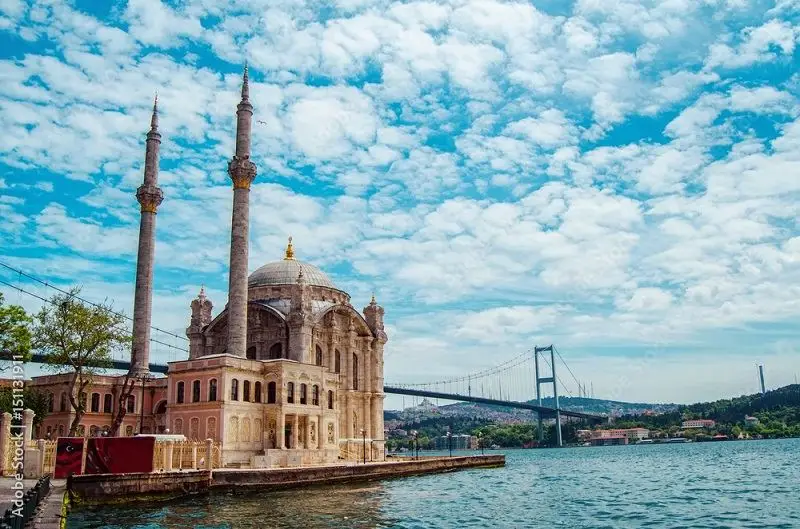
壮大なトルコの建築物
イスタンブールの宮殿と邸宅
ドルマバフチェ宮殿
ドルマバフチェ宮殿は イスタンブール, was originally a bay on the European side of the Bosphorus. Sultan Ahmet I and his successor Osman II gradually filled the bay to expand the imperial garden in the 17th century. Because of this, it eventually earned the name "dolmabahce," which translates to "filled garden." The Besiktas Waterfront Palace, a palace complex, was constructed within the garden in the 17th century as well. During the reign of Sultan Abdulmecid II in the nineteenth century, however, the original wooden palace was torn down and the Dolmabahce Palace was constructed on the site to serve as the main imperial palace. After many years at Fatih's Topkapi Palace, the royal family uprooted and relocated there. The illustrious Balyan family, specifically Nikogos and Karabet Balyan, built Dolmabahce Palace, one of the finest examples of the Neo-Ottoman style, which combined elements of Italian and French Renaissance art with Baroque and Ottoman architecture.
トプカプ宮殿
Located in Istanbul's Fatih District (the historic peninsula), Topkapi Palace was the administrative center and imperial residence of the Ottoman Empire at its height. After Fatih Sultan Mehmet conquered Istanbul in 1451, the first palace structures were constructed between 1451 and 1481. The oldest building, the Cinili Kosk, is located in the first court, which is accessible from the Hagia Sophia square via the Imperial Gate, Bab-i Humayun. The palace structures are located in the second court, which is accessible through the Middle Gate (Bab'us Selam). The Harem Section, where the imperial family lived with their extended families, is accessible via a third court. Finally, at the very end of the building is a covered path leading to the fourth court, which is accessed via the Treasury Room.
キュチュクス・パビリオン
The gardens of the imperial family were the inspiration for the construction of the Kucuksu Pavilion on the Asian side of the Bosphorus in what is now the Kucuksu neighborhood of Beykoz. In the early 1800s, during the reign of Sultan Mahmut, a timber palace with two stories was constructed. It was during Abdulmecid's reign in the 19th century that the original palace was torn down; before that, it had been used by Sultans Selim III and Mahmut II. Nikogos Balyan, of the well-known Balyan family, conceived of and executed the construction of the Kucuksu Pavilion. The pavilion is small because it was designed for the Sultans to use during their brief visits to the countryside or during hunting expeditions in the nearby woods.
イフラムール・パビリオン
The Ihlamur valley, in what is now Istanbul's Besiktas neighborhood, was a popular picnic spot for the city's residents in the 18th century. However, during the reign of Sultan Abdulmecid in the nineteenth century, the Balyan family commissioned the construction of the Ihlamur Pavilions, among many other palaces and pavilions. The two pavilions, the Ceremony Pavilion and the Retinue Pavilion, are both baroque in design.
アインアラク・カヴァク・パビリオン
Only the Aynalikavak Pavilion remains of what was once the Aynalikavak Palace, the fourth largest in Istanbul after Dolmabahce, Topkapi, and Uskudar. It was referred to as both the Tersane (shipyard) palace and the Golden Horn palace due to its location near the old shipyard on the shore of Golden Horn. The first structures of the complex were constructed in the 17th century, but by the end of the 18th century, the pavilion had become known as a palace due to many additions. These structures include the Aynalikavak Pavilion, which some believe dates back to the time of Sultan Ahmet III. However, Sultan Selim III had much of the palace demolished to expand the shipyard. Many of the classics of Ottoman classical music were written by the same Sultan while he was primarily residing at the Aynalikavak Pavilion. Dedicated to his memory, a renowned Ottoman calligrapher etched couplets on the glass.
シャレー・パビリオン
When Sultan Abdulhamid II relocated from Dolmabahce Palace to Yildiz Palace in 1880, he had many new buildings constructed, including a Chalet (Sale) kiosk. Raimondo D'Aronco, a prominent Italian architect of the time, designed and constructed an annex to the palace. Many notable people, including Winston Churchill, Charles de Gaulle, and Kaiser Wilhelm II, stopped by the Sale Kiosk.
イスタンブール郊外にある宮殿や邸宅
農業
イシャク・パシャ宮殿
トルコ南東部の奥地に位置するドゥグベヤズィトの東5キロメートルに、イシャク・パシャ宮殿があります。ここは、シルクロード沿いに位置し、チューリップ時代に建てられた18世紀のオランダ建築の特筆すべき例であり、山の斜面に建てられています。宮殿全体のデザインは、オスマン、ペルシャ、アルメニア、セルジュークの様式が折衷的に融合したものです。外観には、セルジューク美術を彷彿とさせるレリーフや彫刻が施されています。ハレムの扉に刻まれた文字によると、宮殿は1784年にイシャク・パシャによって完成しました。また、木材も装飾要素として使用されており、特に梁の構造は、象徴的な意味を持つ立体的な彫刻として作られています。 トルコ美術において、シャク・パシャは、浴室をモデルにした暖房システムを初めて導入した人物である。19世紀の戦争と地震により、宮殿は甚大な被害を受けたが、1992年に修復プログラムが開始され、2000年には、この建物がユネスコの世界遺産暫定リストに登録された。
アマシヤ
ハゼラン邸
アマシヤのヤルボユ地区にあるハゼランラル邸は、19世紀のオスマン帝国時代の民家建築の優れた例として広く知られています。この地域でよく知られた女性、ハゼラン・ハヌムが、1865年に邸宅の建設を依頼しました。1986年、大規模な改修工事を経て、この邸宅は一般公開され、民族博物館として開館しました。
カラブク
サフランボルの家並み
Safranbolu, a city in northeastern Turkey, allows us to examine Ottoman Period homes from the 18th century. Safranbolu looks like a series of terraces because of the way the river valleys have carved out the landscape. The majority of the homes are two- or three-story structures made of a mixture of wood and stone. Many of the lower stories of Ottoman homes from the 18th century were constructed from stone. The upper floors, which are buttressed, are roomy despite the narrowness of the lots. The axes of the houses are slightly shifted between stories, giving the buildings a slightly twisted appearance; this is because the upper floors were built to let in the maximum amount of sunlight.
城と要塞
イスタンブールの要塞
The city walls of Istanbul are an impressive sight from either the sea or the land. The walls of Constantinople, the most well-known of their type in the late antique and medieval worlds, were constructed by Byzantine Emperor Constantine the Great and encircled the city on all sides. The southern approach was protected by the Marmara walls, while the northern side of the city was encircled by the Golden Horn walls. The land walls of Constantinople protected the city from its enemies and withstood many sieges for more than a thousand years until the Ottomans conquered the city in 1453. These walls were located on the city's western side and ran for about 6 kilometers from the Sea of Marmara to the upper reaches of the Golden Horn. The inner and outer walls, towers, and moats that are still partially intact today were built by Emperor Theodosius II in the first half of the fifth century. The Ottomans have fixed up Constantinople's city walls many times over the centuries, but they still stand as reminders of the city's imperial past.
乙女の塔
Kiz Kulesi (The Tower of the Maiden) is a tower on a small islet at the southern entrance to the Bosphorus, not far from the coast of Uskudar in Istanbul. It has been known as Leander's Tower since the Byzantine era. On a small rock in front of Uskudar, ancient Chrysopolis, a customs house was established to process cargo coming from the Black Sea. The islet's defense wall, remnants of which can be seen today in the water, once connected it to the Asian mainland. A Byzantine garrison was stationed in the tower when Istanbul was conquered by the Ottomans in 1453. Because of its association with the story of Hero and Leander, the tower is often referred to as Leander's Tower. Both an earthquake in 1509 and a fire in 1721 contributed to the tower's demise. After that, it served as a beacon. After serving as a quarantine station, Sultan Mahmud II first renovated the tower in 1832. The harbor authority then renovated it once more in 1945 and finally in 1998 for the James Bond movie "The World Is Not Enough."
A popular café and restaurant now occupy the tower's interior, taking advantage of the building's prime location and its unparalleled panorama of the city's Roman, Byzantine, and Ottoman incarnations. Multiple times a day, private boats travel to the tower to drop off and pick up visitors.
ガラタの塔
高い場所に位置するガラタ塔は、イスタンブールの最も有名なランドマークの一つとなり、ベイオール地区とカラキョイ地区を一望できる。
ビザンツ帝国のユスティニアヌス帝の治世、およそ507年頃、この塔が初めて建設された可能性があります。ジェノヴァ人はこれを「キリストの塔」と呼び、ビザンツ人は単に「大塔」と呼んでいました。ジェノヴァの商人がガラタ地区に居住し、地中海と黒海沿いに交易拠点を設けた頃、この塔は現在の形になりました。
As a result of an earthquake in 1509, the tower suffered damage, but Ottoman architect Hayreddin repaired it. Hayreddin also worked on the restoration of the Sultan Bayezid II complex in Edirne. For the duration of Suleyman the Magnificent's rule, the tower housed convicts who were required to work at the Kasimpasa Naval Dockyard. At the end of the 16th century, the astrologer Takiyuddin Efendi added an observatory at the very top, but the tower was once again used as a prison between the years of 1546 and 1595, during the reign of Sultan Murat III.
The tower served as a fire observatory beginning in 1717 after having been used briefly by the Ottoman military band, the Mehter Band, in the 16th century. After a fire in 1794, the tower had to be rebuilt, and a cumba (projecting balcony) was added. The tower burned down again in 1831 and was rebuilt with an additional two stories and a conical cap.
伝説的なオスマン帝国の飛行家、ヘザルフェン・アフメト・チェレビは、この塔にまつわる興味深い逸話の主人公である。有名なオスマン帝国の旅行家、エヴリヤ・チェレビの記述によれば、ヘザルフェン・チェレビは、腕に取り付けた翼を使って、塔の上からウスクダルまで飛行したという。この驚くべき光景を目にしたスルタン・ムラト・ハンは、彼を疑い、アルジェリアに送ったという。
高さ66.90メートルのこのタワーは、現在人気の観光スポットとなっています。 観光客が訪れるのに適した場所。バルコニーからは、息をのむほど美しいイスタンブールの景色を眺めることができます。
ディヤルバクル
ディヤルバクル城と要塞
The Diyarbakir fortress was initially constructed in the third century AD during the Roman Period and has since been fortified and expanded. The local basalt stone was used to construct the fortress walls, making them the second-widest and longest defensive walls in the world after China's Great Wall. In 2015, UNESCO included the Diyarbakir fortress in its list of World Heritage sites.
バン
ヴァン城
The Urartu kingdom constructed the Van fortress in the 9th century BCE on the eastern shore of Lake Van, directly atop the remnants of their ancient capital, Tushpa. From the Medes to the Armenians to the Parthians to the Romans to the Sassanids to the Persians to the Byzantines to the Arabs to the Seljuks to the Safavids to the Afsharids to the Ottomans to the Russians, this castle has seen it all. Over the centuries, the castle has been occupied by many different cultures, and the building bears the marks of each era's inhabitants. There is an inscription from the reign of Xerxes I, who ruled in the fifth century BCE, on a mosque constructed by Sultan Suleyman in the fifteenth century.
ホサップ城
The 17th-century Hosap Castle stands on the Van-Hakkari road in Van province. The rivers in the area inspired the name, which means "beautiful water." Sari Suleyman Mahmudi, chief of the Mahmudi tribe, commissioned the construction of the castle, which served as the seat of power for the province until the Tanzimat reforms of the nineteenth century.
メルシン
処女の城
Today, you can find Kizkalesi (the Maiden's Castle) on an island in Mersin Province, just 300 meters off the coast of the Mediterranean Sea. The castle, which was originally constructed in the fourth century BCE, underwent major renovations in the thirteenth century. Their north and west walls are excellent case studies of traditional ashlar construction. The castle fell to the Anatolian emirate of Karamanid in the 13th century, and then to the Ottomans in the 14th century.
宿と市場
アクサライ
スルタンハニ(アラエディン・イン)
The Sultanhani (Sultan Inn), constructed by Sultan Alaeddin Kaykubat I in 1229 during the Seljuk Period, is widely regarded as one of the finest examples of Seljuk architecture. The square stone mosque in the inn's courtyard provided a space of spiritual respite for travelers, and those in the nearby city of Aksaray is particularly noteworthy, as are the engravings on the front gate.
イスタンブール
グランド・バザール
イスタンブールのファティフ地区にあるグランド・バザールは、世界で最も古い屋内市場の一つです。その広さは30,700平方メートルにも及び、4,000以上の店舗が軒を連ねています。バザールの原型は、ファティフ・スルタン・メフメトがイスタンブールを征服した15世紀に遡ります。その後、スルタン・スレイマン大帝が1701年に拡張し、現在の規模となりました。長年にわたり、数多くの地震や火災に見舞われてきましたが、その壮大さや重要性は損なわれていません。現在存在する店舗の多くは、1896年の地震以前に建てられたものです。グランド・バザールは現在も活気に満ちており、その運営によって26,000人以上の雇用が創出されています。 ショッピングモールとしても利用されています。ここは世界で最も人気のある歴史的建造物の一つであり、毎日250,000人から400,000人もの観光客が訪れます。
スパイス市場
The Spice Bazaar in the Eminonu neighborhood is Istanbul's second-most-visited market. The New Mosque Complex, which included the Egyptian Bazaar, was commissioned by Hatice Turban Sultan in 1660 and paid for in part by revenues from the Egyptian province of the Ottoman Empire. While スパイスは今でもバザールにおいて重要な役割を果たしている。この地域は経済の中心地であるだけでなく、トルコのお菓子やその他のスイーツ、宝石、お土産、ドライフルーツやナッツなどを販売する多くの店が軒を連ねています。
エディルネ
アリ・パシャ・バザール
スルタン・スレイマンの最後のグランド・ヴィジル(大宰相)であったヘルセキ・セミズ・アリ・パシャは、1569年に建築家シナンに依頼し、このバザールの建設を命じた。バザールの全長は270メートルで、その沿いには約130の店が並んでいる。現在、このバザールでは、衣料品、靴、バッグ、その他の家庭用品に加え、エディルネの土産物など、多種多様な商品が販売されている。
ルステム・パシャの宿
The inn, which was constructed in 1554 at Rustem Pasha's behest by architect Mimar Sinan, is an outstanding example of Ottoman architecture from the 16th century. There are shops on the ground floor and second floor of the inn. Even though it is currently closed, the inn underwent renovations and operated as a hotel after World War II.
マドラサ(神学校)
今夜
カラタイ神学校
コンヤの首長、ジェラレディン・カラタイは、1251年にこの建造物の建設を命じました。この神学校のタイル装飾と装飾は、その美しさと精巧な細部に富んだデザインで特に有名です。セルジューク朝時代のタイル、装飾品、工芸品は、博物館がタイル工芸博物館として改修された後、展示されるようになりました。
シヴァス
ゴク・マドラサ
The Gok Madrasa, which was constructed in 1271, is well-known for the two minarets that flank its main entrance on either side. Animals, stars, and tree silhouettes are etched into the minarets. Due to the use of blue tiles reminiscent of the sky ("gok," which means "sky" in Turkish), the structure was given that moniker. There is only one courtyard in the building, and it has a pool and fountain in it. The courtyard is split in two, with one side leading to the classrooms and the other to the masjid (mescit, the prayer room).
エルズルム
双子のミナレットを持つ神学校
It is in the city of Erzurum, in eastern Turkey, that you'll find the Twin Minaret Madrasa (Cifte Minareli Medresesi). The madrasa likely dates back to the Seljuk era of the 13th century, but this is only a guess. The madrasa is significant not only because it is the largest structure of its kind, but also because of the architectural and decorative innovations it represents. The madrasa, which has two stories, occupies a 35-by-40-meter plot of land. The monument gets its name from the twin brick minarets that stand 26 meters tall on its northern facade. They're affixed to octagonal bases that rest atop square columns. The upper set is adorned with a relief palm tree design, while the lower set features a calligraphic medallion inscribed with Allah, the Prophet, and the four Caliphs.
宗教施設として建てられた建物
イスタンブール
アヤソフィア
Hagia Sophia, located in the Sultanahmet district of Istanbul's historical peninsula, was originally constructed in 537 in Constantinople, the capital of the eastern Roman Empire. The Eastern Roman Emperor Justinian commissioned the construction of what would become the imperial church of the Roman Empire. With the largest interior space of any building at the time, the church is often held up as a paragon of Byzantine design. Isodoros, a mathematician and architect from Miletos, conceived of the structure's layout. Following Fatih Sultan Mehmet's conquest of Istanbul, the Hagia Sophia church was transformed into a mosque. Muslim law forbids the presence of figurative art, so the church's interior was stripped out, and the mosaics were covered with plaster. In its place, Islamic elements like a minbar and minarets were installed. When the Turkish Republic was established, Hagia Sophia was transformed into a museum. Hagia Sophia, a joint Christian and Muslim temple complex, was one of the world's most impressive museums until the year 2020. With the Presidential Decree in July 2020, Hagia Sophia was reopened for worship as the Ayasofya Grand Mosque, and it now serves as a global cultural treasure.
アヤ・イリニ(アギア・イレーネ)
The Hagia Irene church, located in the first courtyard of Topkapi Palace on Istanbul's historical peninsula, was likely constructed in the 4th century. Some accounts, however, place an earlier church on the same site before Constantine I's. Before the original Hagia Sophia was constructed in 360, Hagia Irene was the official church of Constantinople. After the devastating earthquake that struck Constantinople in 740, Hagia Irene was renovated and decorated with mosaics and frescoes during the reign of Emperor Constantine V. However, following the Ottoman conquest of Istanbul in 1453, the church was enclosed within the walls of the Topkapi Palace and began to be used as an arsenal. At the turn of the 20th century, the church was first used as a military museum. It stayed that way until the late 1970s, when it was turned into a concert hall for classical music.
カリーエ博物館(コーラ教会)
Originally constructed as part of a rural monastery complex outside the city walls of Constantinople, the Chora Church can be found in the Edirnekapi quartier of Istanbul, known as Kariye. Its original name was Church of the Holy Saviour in the Country, but after the city walls were expanded and it was incorporated into the city proper, it became known simply as Chora. In the 12th century, Maria Dukaina, the mother-in-law of Byzantine Emperor Alexius Komnenos, rebuilt the church into its current form. The famous mosaics and frescoes were added by the powerful Byzantine statesman Theodore Metochites in the 14th century. One of the best examples of Palaiologan Renaissance art can be found in the church's mosaics. The church was turned into the Kariye Mosque after Istanbul was conquered, and the frescoes and mosaics inside were covered with plaster. The frescoes were discovered during a lengthy restoration process after the mosque was transformed into a museum in 1945. The Kariye Mosque, which has been turned into a museum while extensive restoration work continues, will remain closed until the year 2020.
スルタンアフメット・モスク(ブルー・モスク)
Sultanahmet Mosque, also known as the Blue Mosque, is an active mosque from the Ottoman era located in the Fatih neighborhood on Sultanahmet Square. The mosque was built in the early modern period, between 1609 and 1616, by Sultan Ahmet I. Its interior is adorned with ornate mosaics and mosaic domes. The town of Iznik, Turkey, is famous for the superior quality of the Iznik tiles that feature blue as the dominant color. More than 20,000 tiles in more than 50 different tulip designs adorn the lower levels. The mosque's high number of minarets (six) is another notable aspect, as it is in keeping with the mosque's grandiosity and the overwhelming interior decoration.
スレイマニエ・モスク
偉大な建築家であるシナンは、スルタン・スレイマン(スルタン・スレイマン大帝)から、オスマン帝国時代で最も重要な皇室モスクの一つであるスレイマニエ・モスクの建設を依頼された。コンスタンティノープル全体を見下ろす丘の上に位置するスレイマニエ・モスクは、その戦略的な配置から、非常に大きく、圧倒的な存在感を放っている。2019年にチャムルジャ・モスクが建設されるまでは、イスタンブール最大のモスクとして知られていた。
バン
アクダマル教会
The Akdamar Church was constructed between the years 915 and 921 on Akdamar Island, which is part of Lake Van in the province of Van in eastern Turkey. Bishop Manuel, an architect, was tasked with the project after it was commissioned by Gagik I Ardzruni, the king of Armenia. The "Hripsime Type" is characterized by its construction from red cut tufa stone and its design resembling a four-lobed clover. Architectural reliefs depicting religious scenes adorn the church's exterior. They are widely hailed as some of the finest manifestations of medieval art. Bible-themed frescoes adorned the interior walls. While it has been a museum since 2007 (when it was closed for good), the church is still open once a year for religious services.
アンタルヤ
聖ニコラス教会
現在のトルコ南東部に位置する古代都市ミラには、聖ニコラウス教会があります。これは古代東ローマ帝国のバシリカ様式の教会です。この建物は、現代ではサンタクロースまたはクリスマスのおじいさんとして知られる聖ニコラウスの墓の上に、西暦520年に建てられました。この教会は、単なる礼拝の場であるだけでなく、ビザンツ建築の優れた例であり、トルコ国内でも最も美しい壁画のいくつかがあるため、重要な意味を持っています。
トラブゾン
スメラ修道院
The Orthodox Sumela Monastery can be found in the Zigana Mountains of Trabzon Province, Turkey, which is on the northern Black Sea coast of the country. The exact date of the monastery's construction is unknown, but it is thought to have begun in the 4th century, during the reign of Emperor Theodosius I. The monastery is a stunning structure, built on rocks and accessible via a path through the forest, and is particularly well-known for its 18th-century frescoes depicting biblical scenes from the lives of Christ and the Virgin Mary. The monastery was closed and turned into a museum in 1923, but on August 15, 2010, it hosted an Orthodox Mass for the first time since then.
エディルネセリミエ・モスクThe square mosque is a work of architecture, with a single massive dome and four slender minarets. It is on the UNESCO World Heritage List. Architect Sinan, who lived in the 16th century, at the height of the Ottoman Empire under Suleyman the Magnificent, is unquestionably the most 著名な建築家 of the Ottoman period. Edirne, formerly known as Hadrianapolis, was the Ottoman capital before Istanbul and is home to the Selimiye Mosque. Selimiye Mosque was Sinan's "masterpiece," according to the architect himself. At the age of eighty, during the reign of Sultan Selim II, he built the Selimiye Mosque (1568–1575).
Sinan's skill as a city planner is further evidenced by the mosque's prominent location, which allows it to be admired from far away. As the finest example of any mosque with eight columns, this structure is the pinnacle of his centralized-domed plans, with a great central dome rising on eight massive columns and impressive, recessed arcades in between. Typical of Ottoman mosque design is the soaring, elegant domes and towering, skinny minarets. The Selimiye Mosque, on the other hand, is one of the most beautiful and historically significant mosques in the world. It is a massive complex that includes a mosque, two square madrasas, a shopping arcade (arasta), and a theological school that measures 190 by 130 meters. The structure is supported by eight enormous columns and eight smaller muqarnas domes. The muqarnas extend outward and rise, producing a corbelled effect and leaving more floor space below so that the eye can be drawn directly to the dome.
アンカラハジュ・バイラム・モスクアンカラの城壁の外れにある地区、ウルースには、ハジュ・バイラム・モスクがあります。この地域には、1923年にトルコ初の国会議事堂が建設されました。ハジュ・バイラム・モスクやアウグストゥス神殿など、オスマン帝国時代やトルコ共和国初期の建物を含む、伝統的な歴史的景観の一部となっています。この地区は、かつて古墳があった丘の上に位置しています。この場所は、紀元前8世紀頃から、異教徒とイスラム教徒の両方のコミュニティによって、古代アンキュラの神殿(アクロポリス)として崇められてきました。
The Haci Bayram Mosque, which dates back to the 15th century, is one of the most significant mosques in Ankara and continues to play a significant role in the city's religious life. In the eighteenth century, it underwent a transformation that made it look like a mosque from the late modern era. The absence of a dome and the use of a wooden ceiling are the mosque's most distinctive architectural features. Designer Mehmet Bey was responsible for its construction.
貯水槽と水道橋
イスタンブール
バシリカ・シスタン
The Basilica Cistern is Istanbul's largest and oldest underground water reservoir still in use today. Southwest of Hagia Sophia, on First Hill, is where you'll find the cistern. Before the cistern was built, there stood a massive basilica, erected in the third and fourth centuries B.C. during the Early Roman era as a commercial, legal, and artistic hub. In 476, a fire swept through the building and put it out of commission forever. In the early sixth century, during the reign of Emperor Justinian I, the Basilica Cistern was constructed. The cistern supplied water to the Great Palace and other nearby structures, including gardens, courtyards, and palaces. Water piped in from the Belgrade forest, 20 kilometers away, was used to fill the cistern. The Yerebatan Palace (Yerebatan Sarayi) is 138 by 64 meters in size and is held up by 336 columns that were relocated from other ancient structures. It is estimated that 100,000 metric tons of water can be stored in the cistern. Topkapi Palace's water supply came from this cistern, the only ancient cistern still in use in modern times. In 1985, the cistern was renovated, and wooden walking platforms were added; the structure has been a museum since 1987.
ウズンケメル(長い水道橋)
It was in 1563, during the reign of Sultan Suleyman the Magnificent, that Architect Sinan built the Long Aqueduct as part of the Kirkcesme Water Supply System. This was the biggest job this well-known architect had ever worked on. The line's buildings were damaged by the devastating floods of the same year, but they were quickly repaired. Because of this, we can assume that the Kirkcesme water system was finished in the year 1564. The Belgrade Forest is located in northern Istanbul, and this system collects surface water from the area around it and transports it into the city. The western and eastern branches are the two most prominent parts of the system. The Long Aqueduct can be found in the west. There are a total of 33 massive aqueducts that make up the system. One of these aqueducts, known as the Long Aqueduct, features 97 individual arches to carry water under the ground. It has a length of 711 meters and a height of 25 meters.
キリクケメル(崩壊した水道橋)
The Kirikkemer Broken Aqueduct is a component of Sinan's Kirikcesme Water Supply System, which was completed in 1564. To transport water throughout the city, the Kiriksesme water system uses 33 aqueducts and 55,374 meters of conduit lines. It has two branches—one to the east and one to the west—and collects water from sources in the city's northern reaches. In Kemerburgaz, on the line's eastern branch, you'll find the Broken Aqueduct. It has a length of 207 meters and a height of 35 meters, making it the tallest aqueduct in the system. Three of the arches have been positively identified as late Roman relics. Because of its abrupt 90-degree turn after a certain point, the Kirik (broken) or Egri (curved) Aqueduct has earned its unwieldy nicknames.
ヴァレンス水道橋
Istanbul's ancient water distribution system includes the Valens Aqueduct. The Thracian Water Supply System, of which remnants exist, is the largest ancient water distribution network known. The Valens Aqueduct brought water from the Thracian peninsula to the city's core, where it filled the Nymphaeum Maximum in the Theodosius Forum (Beyazit Square) and then the Binbirdirek Cistern. During the time of the Roman Emperor Valens, the building was finished (364–378). The building's original length was likely around 971 meters, and its height was likely around 27 meters. In the Middle Ages, the system was still in use, despite several supply line interruptions caused by earthquakes and war. The aqueduct became part of the city's primary water distribution system in the 15th century (during the reign of Sultan Mehmet II).
病院と温泉施設
シヴァス
ディヴリギのモスクと病院
It's a pretty cool mosque/hospital complex. Sivas Province is home to the Divrigi Castle, as well as the Divrigi Mosque and Hospital. Turan Melek, Ahmet Shah's wife, established the two-story hospital in 1228–1229; architect Hurrem Shah also designed the mosque. They buried both Ahmet Shah and Turan Melek in the hospital's tomb section. Vault construction and carved decorations are two of the complex's most recognizable features. Porticoes, mihrabs, minbars, and piers are all lavishly adorned. Its rich examples of Anatolian traditional stonework, in addition to its architecture, earned it a spot on the UNESCO World Heritage List.
アマシヤ
ダルッシーファ(病院および療養所)
Located in Amasya, Turkey, on the Black Sea coast, Darussifa is a health and wellness center that also serves as an asylum. It was erected by ldiz Hatun at the start of the 14th century in the name of her husband Sultan Olcayto, during the rule of the Ilkhanates. It was a medical center for both treatment and education that provided its services to patients at no cost, following the model of charitable foundations common in Turkish-Islamic culture. Darussifa, which means "door of health," is a direct translation of the Arabic word. The structure has vaulted hallways and rooms, as well as a courtyard with arches on two sides. The structure mimics a traditional Islamic school or madrasa. Sabuncuzade Serafeddin bin Ali, a prominent physician, received his medical training there. The book he wrote, Kitab-ul Cerrahiya-i lhaniyye (The Surgery Book of the lkhanate), made him famous. The building's history of using music as therapy for those with mental illness is reflected in its current use of music therapy. Having served as the Municipal Academy of Music since 1997, it has been in continuous operation since then.
ブルサ
ブルサの古代温泉浴場
Bursa, also known as ancient Prusa, is a historical town in the northwest of Turkey that is well-known for its natural hot spring baths. Cekirge, a village in Turkey, is well known for its therapeutic hot springs and has numerous such baths spread throughout the town. In the sixth century, during the reign of Eastern Roman Emperor Justinian I, the original baths of Cekirge were constructed. In the following centuries, during the Ottoman period, the Byzantine domed baths were renovated and enlarged by Sultan Beyazit II, and today they continue to attract tourists. The "silver water" of Bursa is said to come from the mythical Mount Olympus in Mysia, and it is used in many of the city's old Turkish baths.
イズニク
イスマイル・ベイ浴場
イズニクのイスタンブール門近くにある小さなハマム(トルコ式風呂)を、地元の有力者であるイスマイル・ベイが私用の入浴施設として利用していたと考えられています。15世紀から16世紀にかけて建てられたこのハマムのドームは、その美しいデザインで知られています。
噴水
ドイツの噴水
The German Fountain (or Kaiser Fountain) is one of many historic fountains on Sultanahmet Square in Istanbul's historical peninsula. Between 1988 and 1901, the fountain was handcrafted in Germany and then shipped to Istanbul, where it was put together. Kaiser Wilhelm II of Germany commissioned the construction of the octagonal, neo-Byzantine-style fountain as a gift to the city of Berlin. Golden mosaics adorn the interior of the dome's ceiling.
ミフリサ・スルタンの噴水Located in the Kucuksu district's Pavilion, this fountain was commissioned by Sultan Selim III in 1806 to honor his mother, Mihrisah Sultan. The building, which is near the Bosphorus, has become a symbol of the area because it is often shown in old drawings of the area.